Digital Preeyam News

AI for Teacher: 7 Powerful Ways to Understand and Use AI in Education – Digital Preeyam News

AI-for-Teacher-7-Powerful-Ways-to-Understand-and-Use-AI-in-Education-Digital-Preeyam-News

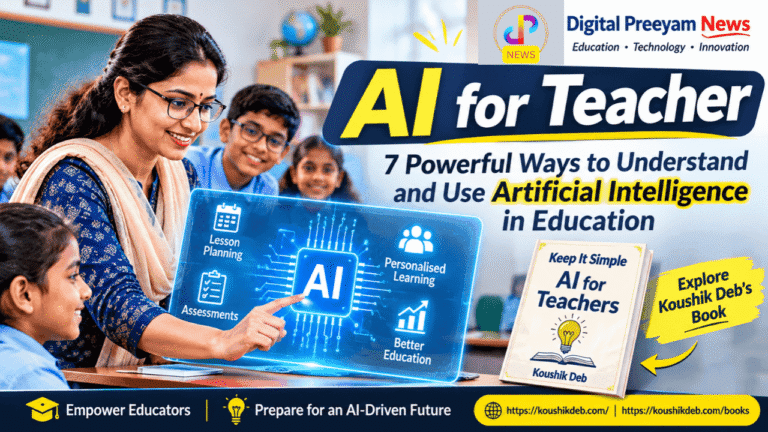
AI for Teacher: 7 Powerful Ways to Understand and Use Artificial Intelligence in Education

Artificial intelligence is creating new possibilities for modern education. From preparing lesson materials and supporting personalised learning to understanding AI-powered recommendation systems, teachers are increasingly exploring how emerging technologies can improve classroom experiences. As AI becomes more accessible, developing practical AI knowledge is becoming an important part of modern teaching.
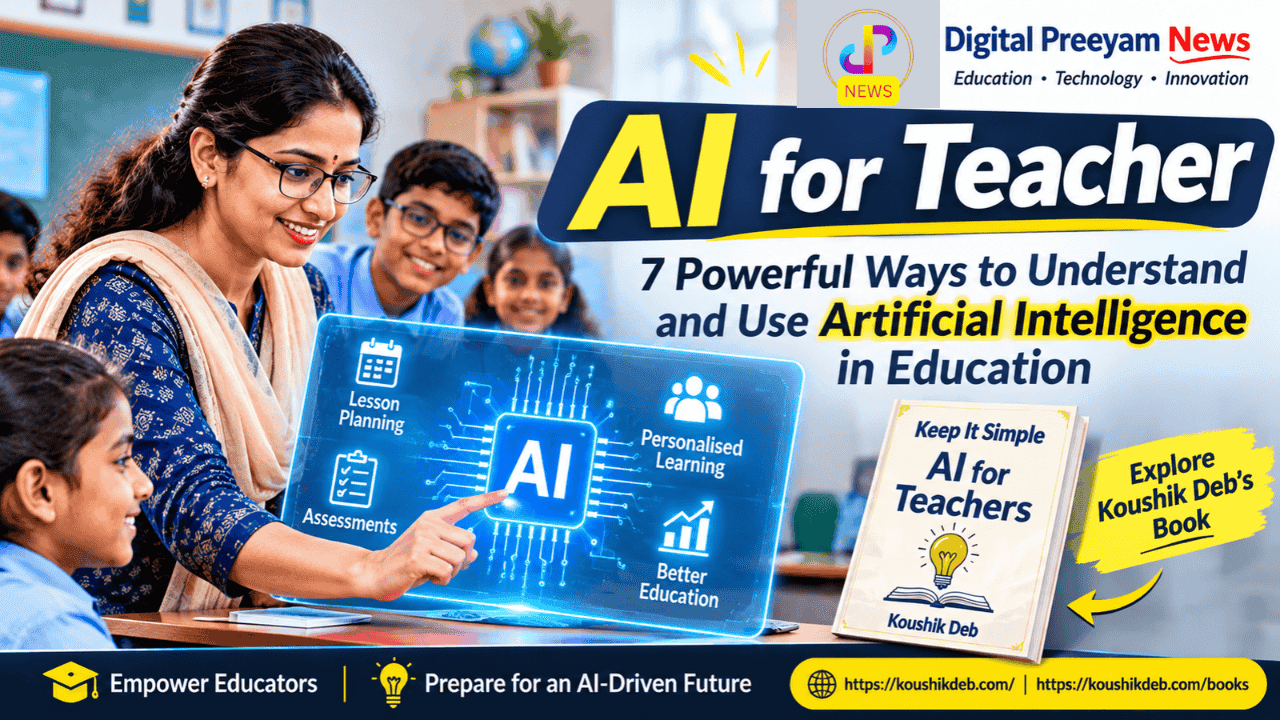
AI for Teacher: Understanding and Using Artificial Intelligence in Education

Why AI for Teacher Knowledge Is Becoming Important

The role of teachers is evolving alongside technological developments. Traditionally, educators have relied on textbooks, classroom discussions, examinations and educational resources to support student learning. Today, artificial intelligence is introducing additional possibilities for preparing educational content, organising information and exploring different teaching approaches.

The growing interest in AI for teacher applications reflects a broader transformation in education. Teachers can now explore AI-powered platforms to develop lesson outlines, generate practice questions, simplify complex topics and create learning materials suitable for different academic levels.

However, understanding artificial intelligence involves more than learning how to operate a chatbot. Educators also need to understand how AI systems process information, identify patterns, generate recommendations and sometimes produce inaccurate results.

This knowledge can help teachers make informed decisions about when AI is useful and when traditional teaching methods remain more appropriate.

7 Practical Ways Teachers Can Explore Artificial Intelligence

Artificial intelligence can support several aspects of educational work. Its usefulness depends on the learning objectives, the quality of the technology and the educator's ability to evaluate its output.

1

Preparing Lesson Plans and Educational Materials

Lesson preparation requires time, subject knowledge and an understanding of students' learning requirements.

AI-powered tools can help teachers develop initial lesson outlines, discussion topics, classroom activities and educational worksheets.

For example, a teacher preparing a science lesson can provide the subject, class level and learning objectives to an AI application and request a structured teaching outline.

The generated material can then be reviewed, corrected and adapted according to the school's curriculum.

AI should assist with preparation rather than replace the teacher's subject knowledge and professional judgement.

2

Supporting Personalised Learning

Students do not always learn at the same pace. Some may understand a concept quickly, while others require additional explanations and practice.

Artificial intelligence can help educators explore different ways of presenting the same educational concept.

For example, a teacher could use an AI application to prepare:

  • Simplified explanations for beginners.
  • Additional exercises for students who need practice.
  • Advanced questions for students who have mastered a topic.
  • Examples connecting theoretical concepts with everyday situations.

This approach can support differentiated instruction while allowing teachers to remain responsible for understanding individual student needs.

3

Understanding AI Recommender Systems in Education

One interesting area of artificial intelligence is AI recommender systems.

These systems analyse available information, identify patterns and generate suggestions based on particular requirements or preferences.

Many people encounter recommendation systems when using online shopping platforms, video streaming services and digital learning applications.

In education, similar technologies can help recommend learning materials, practice exercises and educational resources based on a learner's progress or interests.

For example, an educational platform might recommend additional mathematics exercises after identifying areas where a student needs more practice.

Teachers can use this concept to understand how technology may support personalised learning.

However, recommendations should not automatically be treated as correct. Educators must consider whether suggested materials are appropriate, accurate and aligned with learning objectives.

4

Creating Questions, Worksheets and Assessments

Preparing assessment materials is another area where AI applications may assist educators.

Teachers can explore AI tools to generate:

  • Multiple-choice questions.
  • Short-answer questions.
  • Subject-specific worksheets.
  • Revision exercises.
  • Classroom quizzes.
  • Discussion-based activities.

For example, an educator teaching history could request questions about a particular historical period at different difficulty levels.

The generated questions can provide a starting point for assessment preparation.

Teachers should independently verify factual accuracy, answer keys, difficulty levels and alignment with the prescribed syllabus before using the material.

5

Making Complex Subjects Easier to Understand

Some academic concepts require multiple explanations before students fully understand them.

Generative AI can help educators experiment with alternative explanations, examples and analogies.

A physics teacher, for instance, might request a simple explanation of electricity using everyday household examples.

Similarly, a mathematics teacher could explore different approaches to explaining fractions or algebra.

This flexibility can help educators prepare additional learning resources for students with different levels of understanding.

6

Exploring Multilingual Educational Resources

Language accessibility is an important consideration in a diverse educational environment such as India.

Students may understand difficult subjects more comfortably when explanations are available in languages they use regularly.

AI-powered language technologies can help teachers explore translation, summarisation and multilingual educational content.

However, AI-generated translations and explanations should be checked carefully. Technical terminology, cultural context and subject-specific meanings may not always be preserved accurately. Teachers should ensure that multilingual resources communicate the original educational concept correctly.

7

Improving Educational Planning and Administrative Work

Teachers also manage responsibilities beyond classroom instruction.

These may include preparing notices, organising educational activities, creating reading lists, drafting feedback and maintaining learning resources.

AI applications can assist with preparing initial drafts and organising information.

For example, teachers may use AI to develop a draft parent communication or organise a list of classroom activities.

The final content should always be reviewed before it is shared with students, parents or educational institutions.

Understanding the Connection Between AI for Teacher and AI Engineering

To use artificial intelligence responsibly, educators can benefit from understanding the basic principles behind the technology.

This is where the role of an AI Engineer becomes relevant.

An AI Engineer works with artificial intelligence technologies to design, develop, test and implement systems that perform tasks such as recognising patterns, processing language, analysing information and generating predictions.

These professionals work with areas including:

  • Machine Learning
  • Generative Artificial Intelligence
  • Natural Language Processing
  • Large Language Models
  • Deep Learning
  • AI-Powered Recommendation Systems

Teachers do not need to become AI Engineers to use artificial intelligence in education. However, understanding the fundamentals can help them recognise how AI applications operate and why their outputs sometimes require verification.

For example, a generative AI application may produce an apparently convincing explanation without having properly verified every statement. Understanding this limitation encourages educators to evaluate information rather than accept every generated response.

AI Engineer Requirements: What Teachers and Students Should Understand

The growing adoption of artificial intelligence is also attracting interest in careers related to AI engineering.

Although teachers do not require the same technical qualifications as AI professionals, understanding AI Engineer requirements can help educators explain the skills associated with this developing field to students.

A professional career in AI engineering generally involves knowledge of several technical areas:

Programming

Python is widely used in artificial intelligence and machine learning development.

Mathematics and Statistics

Linear algebra, probability, statistics and mathematical reasoning provide important foundations for understanding AI models.

Machine Learning

Understanding how systems learn patterns from data and generate predictions.

Data Processing

Working with datasets, identifying patterns and preparing information for machine learning applications.

Natural Language Processing

Understanding technologies that allow computers to process and generate human language.

Problem-Solving

Developing the ability to analyse technical challenges and design appropriate solutions.

These requirements may vary depending on the position, organisation and area of specialisation. Introducing students to these concepts through age-appropriate educational activities can help them understand the relationship between classroom learning and future technology careers.

AI Engineering | Research | Education

Koushik Deb: Connecting AI Engineering, Research and Education

As artificial intelligence becomes increasingly relevant to education, professionals working in the AI industry can provide useful perspectives on how these technologies are developed and applied.

Koushik Deb is an AI Engineer and Tech Lead at Accenture. He is also a PhD candidate at the Indian Institute of Information Technology (IIIT) Kalyani.

His professional experience includes work involving Generative AI, Agentic AI, Natural Language Processing, machine learning and large language models.

Alongside his industry responsibilities, his academic research focuses on bias detection and mitigation in multilingual large language models, particularly across English, Hindi and Bengali.

His professional journey also includes experience at organisations such as Cognizant, IBM and Capgemini. He previously worked as an Assistant Professor in Computer Science at the Institute of Engineering & Management, Kolkata.

The combination of industry experience, academic research and teaching experience provides an interesting perspective on the importance of making artificial intelligence understandable beyond technical environments.

For educators who are beginning to explore AI, accessible explanations can be particularly valuable because understanding the technology should not require an advanced computer science background.

Explore Koushik Deb's professional background and AI research through his official website:

Visit Koushik Deb's Official Website

Koushik Deb, AI Engineer and Tech Lead at Accenture, and PhD candidate at IIIT Kalyani
Koushik Deb AI Engineer | Tech Lead | PhD Candidate
Recommended Reading

Recommended Reading: Keep It Simple – AI for Teachers by Koushik Deb

Understanding artificial intelligence can initially seem challenging for educators who have limited exposure to technical subjects.

Technical terminology, unfamiliar concepts and rapidly changing applications may make it difficult to identify where to begin.

To address this learning interest, Koushik Deb has written a book titled Keep It Simple: AI for Teachers.

The publication is designed as a plain-language introduction to artificial intelligence for teachers who want to understand the subject and explore its relevance to education without requiring an advanced technical background.

It is part of the Keep It Simple book series.

For teachers, academic professionals and education enthusiasts, the publication offers an opportunity to explore AI-related knowledge from an educational perspective.
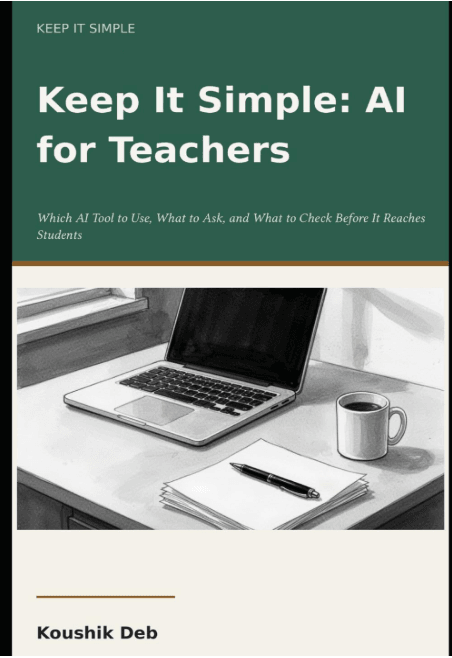
Keep It Simple: AI for Teachers book written by Koushik Deb
Keep It Simple: AI for Teachers
Written by Koushik Deb

Who May Find This Book Relevant?

The book may be of interest to:

  • School teachers exploring artificial intelligence.
  • Educators interested in educational technology.
  • Academic professionals developing their AI literacy.
  • Teachers who want to understand AI beyond basic chatbot usage.
  • Readers interested in the relationship between artificial intelligence and modern education.

Educators interested in the publication can explore its description and sample through the official book page.

Explore Keep It Simple: AI for Teachers by Koushik Deb:

Discover the Official Book Page

Responsible AI Use: What Every Teacher Should Remember

Although artificial intelligence offers several educational possibilities, its use requires appropriate supervision.

Teachers should consider the following principles before introducing AI applications into educational activities.

Verify AI-generated information

AI systems can produce incorrect explanations, references and answers. Important educational content should be checked against reliable sources.

Protect student privacy

Personal information, student records and confidential institutional data should not be entered into AI platforms without appropriate authorisation and safeguards.

Maintain academic integrity

Students should understand the difference between independent work and AI-generated content.

Avoid excessive dependence

AI should support learning and problem-solving rather than replace independent thinking.

Consider fairness and accessibility

Educational AI applications should be evaluated for language limitations, potential bias and their suitability for different learners.

The objective should be to make technology a supportive part of education while maintaining the importance of human guidance.

The Future of AI for Teacher Development

The growing use of artificial intelligence is creating new opportunities for teachers to explore educational technology, personalised learning and digital resources.

However, successful adoption will require more than access to AI applications.

Educators need opportunities to develop practical AI literacy, understand the limitations of automated systems and evaluate whether particular technologies genuinely support learning objectives.

An understanding of AI recommender systems, machine learning and generative AI can also help teachers introduce students to the wider technological developments shaping modern industries.

The role of an educator will remain important in this changing environment. AI may assist with information processing and educational preparation, but teachers continue to provide context, mentorship, encouragement and human understanding.

Resources such as Koushik Deb's Keep It Simple: AI for Teachers can be relevant to educators who want to begin developing this knowledge.

Conclusion: Making Artificial Intelligence Understandable for Every Teacher

The growing importance of AI for teacher development reflects a wider transformation in education and technology.

From lesson preparation and personalised learning to educational recommendations and multilingual resources, artificial intelligence can provide additional ways to support teaching activities.

At the same time, educators must understand that AI-generated information requires evaluation, responsible use and human supervision.

Teachers do not need to become programmers or AI Engineers to begin exploring these technologies. Developing foundational knowledge and practical awareness can be a meaningful first step.

As artificial intelligence continues to evolve, the focus should remain on using technology thoughtfully to improve educational experiences while preserving the essential human role of teachers.

For educators interested in learning more, Keep It Simple: AI for Teachers by Koushik Deb is a relevant publication to explore.

About Digital Preeyam News

Digital Preeyam News covers education, technology, research, innovation and developments shaping the modern world. Its Education section brings readers informative stories and insights into emerging academic trends and technological advancements.

Writer Preeyam Kumar Prasad
Publication Digital Preeyam News
Category Education

Social Media Profiles

Follow Digital Preeyam News on social media for the latest stories, insights and updates.

Frequently Asked Questions (FAQs)

1. What is AI for teacher?

AI for teacher refers to the use of artificial intelligence technologies to support teaching activities such as lesson planning, educational content preparation, assessments, personalised learning and classroom resource development.

2. How can teachers use artificial intelligence in education?

Teachers can use AI applications to prepare lesson outlines, generate worksheets, develop quizzes, simplify difficult concepts, explore multilingual resources and organise educational materials.

3. Do teachers need programming skills to use AI?

No. Teachers can begin using many AI-powered educational applications without programming knowledge. However, understanding basic AI concepts, limitations and responsible usage is important.

4. What are AI recommender systems in education?

AI recommender systems analyse available information and suggest relevant learning materials, exercises or educational resources based on learner requirements, preferences or progress.

5. What are the basic AI Engineer requirements?

AI engineering generally requires knowledge of programming, mathematics, statistics, machine learning, data processing and problem-solving. Specific requirements depend on the job role.

6. Can artificial intelligence replace teachers?

AI can support educational activities, but it cannot fully replace the human guidance, mentorship, emotional understanding and professional judgement provided by teachers.

7. Who wrote Keep It Simple: AI for Teachers?

Keep It Simple: AI for Teachers was written by Koushik Deb, an AI Engineer and Tech Lead at Accenture and a PhD candidate at IIIT Kalyani.

8. Where can teachers explore Keep It Simple: AI for Teachers?

Teachers and education professionals can visit Koushik Deb's official Books page to explore the publication, its sample and the latest release and purchasing information.

Related Updates:

AI for Teacher: 7 Powerful Ways to Understand and Use AI in Education – Digital Preeyam News

AI for Teacher: 7 Powerful Ways to Understand and Use Artificial Intelligence in Education Artificial intelligence is creating new possibilities for modern education. From preparing lesson materials...

AI Curriculum in India: Koushik Deb on Teacher Readiness | Digital Preeyam News

AI Curriculum in India: Koushik Deb Highlights the Importance of Teacher Readiness and Responsible AI Education India’s education system is entering an important phase as Artificial Intelligence...

ChatGPT Prompts for Teachers: 15 Useful Examples for Better Teaching – Digital Preeyam News

ChatGPT Prompts for Teachers: 15 Useful Examples for Better Teaching and Classroom Preparation As generative AI becomes more accessible, teachers are exploring new ways to prepare educational...

Artificial Intelligence in Education: 7 Powerful Ways to Transform Teaching – Digital Preeyam News

Artificial Intelligence in Education: 7 Powerful Ways AI Is Transforming Modern Teaching and Learning How Artificial Intelligence Is Transforming Modern Education Artificial Intelligence in Education...

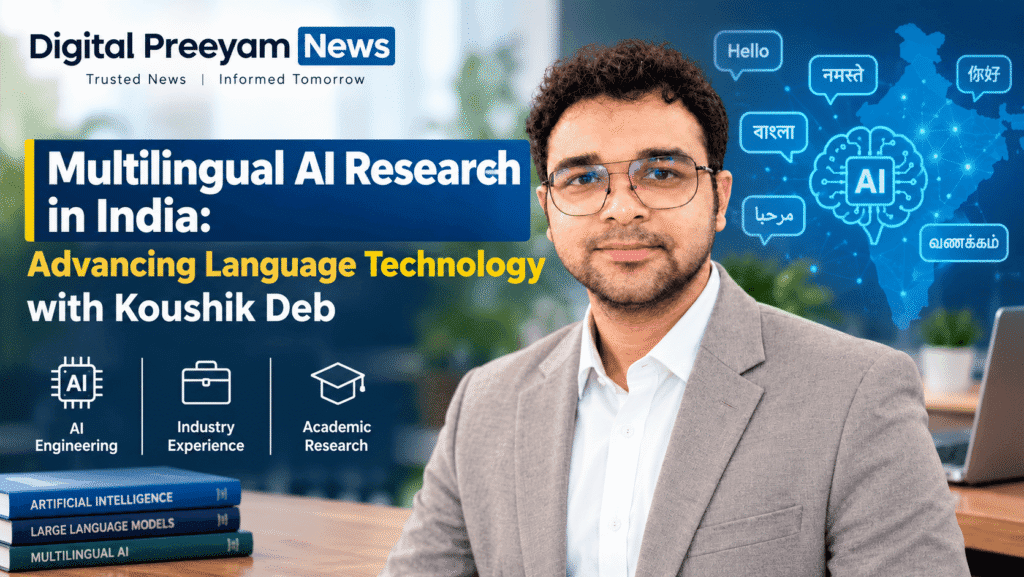
Promising #1 Multilingual AI Research in India: Koushik Deb’s Research Focus – Digital Preeyam News

Multilingual AI Research in India: Advancing Language Technology Artificial intelligence is changing how people communicate, learn and access information. From educational platforms to digital...

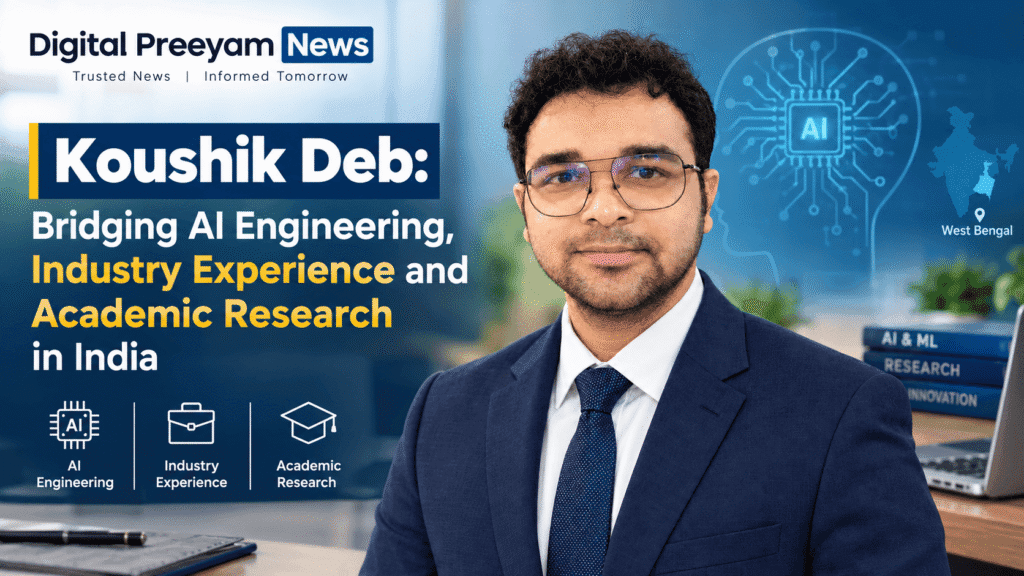
Koushik Deb: Bridging AI Engineering, Industry Experience and Academic Research in India – Digital Preeyam News

Koushik Deb: Exploring the Intersection of AI Engineering and Research West Bengal has a growing presence in India’s technology and research landscape, with professionals contributing to fields...

Leave a Comment

Your email address will not be published. Required fields are marked *