ChatGPT Prompts for Teachers: 15 Useful Examples for Better Teaching and Classroom Preparation
As generative AI becomes more accessible, teachers are exploring new ways to prepare educational materials, organise academic activities and simplify everyday classroom responsibilities. Learning how to write effective ChatGPT prompts can help educators use artificial intelligence more purposefully while maintaining their professional judgement.
The increasing popularity of generative artificial intelligence is creating new possibilities across the education sector. Among the available applications, ChatGPT has attracted attention for its ability to understand instructions, generate written content, organise information and assist with different academic tasks.
For teachers, however, getting useful results from an AI application is not simply about entering a question. The way an instruction is written can significantly influence the quality, relevance and usefulness of the response.
This is why learning to create effective ChatGPT Prompts for Teachers is becoming an interesting area of exploration for educators, academic professionals and individuals interested in educational technology.
Whether preparing a lesson outline, developing classroom exercises or explaining a difficult subject, a well-structured prompt can help teachers communicate their requirements more clearly to an AI system.
Why Are ChatGPT Prompts Important for Teachers?
A prompt is an instruction or question provided to an AI application to generate a particular response. It can include information about the subject, educational level, intended audience, format and expected outcome.
For example, simply asking ChatGPT to prepare a science lesson may produce a general response. However, providing the class level, topic, learning objectives and preferred teaching approach can help generate more relevant material.
Teachers can also refine their instructions through follow-up questions. This makes AI interaction a process of reviewing, improving and adapting generated information rather than accepting the first response without evaluation.
Understanding this process can help educators explore generative AI more effectively.
15 Practical ChatGPT Prompts for Teachers:
The following examples demonstrate how educators can use structured instructions for different classroom and academic activities. Each prompt can be customised according to the subject, curriculum and students’ learning requirements.
1. Creating a Structured Lesson Plan
Prompt:
“Act as an experienced school educator. Prepare a detailed lesson plan on [topic] for students in Class [grade]. Include learning objectives, an introduction, key concepts, classroom activities, teaching materials and a short assessment. Use clear and age-appropriate language.”
This prompt can help teachers organise their lesson preparation into manageable sections.
2. Preparing Multiple-Choice Questions
Prompt:
“Create 15 multiple-choice questions on [subject or topic] for students in Class [grade]. Include four answer options for each question, indicate the correct answer and provide a brief explanation. Arrange the questions from easy to moderately difficult.”
Teachers can use the generated questions as a starting point for classroom quizzes and revision exercises.
3. Developing Practice Worksheets
Prompt:
“Prepare a student worksheet on [topic] for Class [grade]. Include fill-in-the-blanks, short-answer questions, matching exercises and problem-solving activities. Provide an answer key separately.”
This can help educators prepare supplementary learning materials for classroom practice.
4. Explaining Difficult Concepts in Simple Language
Prompt:
“Explain [difficult concept] in simple language for students in Class [grade]. Use everyday examples, step-by-step explanations and a short summary. Avoid unnecessary technical terminology.”
Teachers can use this approach to explore alternative explanations when students find a particular subject challenging.
5. Creating Classroom Discussion Questions
Prompt:
“Generate 10 interesting classroom discussion questions about [topic] for [grade or age group]. Include questions that encourage curiosity, critical thinking, reasoning and student participation.”
Discussion-based activities can encourage students to express their ideas and consider different perspectives.
6. Preparing Homework Assignments
Prompt:
“Create a homework assignment on [subject and topic] for students in Class [grade]. Include five short-answer questions, three application-based questions and two creative activities. Keep the difficulty appropriate for the students’ academic level.”
Teachers can modify the generated assignment according to their syllabus and classroom requirements.
7. Developing a Classroom Activity
Prompt:
“Suggest five interactive classroom activities to teach [topic] to students in Class [grade]. For each activity, explain the objective, materials required, instructions and expected learning outcome.”
This can provide ideas for making lessons more participatory and engaging.
8. Preparing a Subject Revision Guide
Prompt:
“Prepare a revision guide for [subject and topic] for students preparing for [examination name]. Include important concepts, key definitions, short summaries, frequently tested areas and practice questions.”
Teachers can review the suggested material and align it with the actual examination syllabus.
9. Creating Vocabulary and Language Exercises
Prompt:
“Prepare an English vocabulary exercise for students in Class [grade]. Include 15 useful words, their meanings, example sentences, synonyms and a short practice exercise.”
Language teachers can adapt the generated exercises to support vocabulary development and writing practice.
10. Designing a Science Experiment Explanation
Prompt:
“Explain a simple classroom science experiment related to [scientific concept]. Include the objective, materials, procedure, scientific explanation, expected observation and safety precautions. Make it suitable for students in Class [grade].”
Teachers should independently verify the scientific information and ensure that any proposed experiment is safe before conducting it.
11. Preparing Student Feedback
Prompt:
“Help me create constructive and encouraging feedback for a student who has demonstrated [specific academic strength] but needs improvement in [specific area]. Use supportive language and suggest practical steps for improvement. Do not include personal information.”
Educators can use the response as a starting point for personalised feedback while retaining responsibility for the final assessment.
12. Simplifying a Reading Passage
Prompt:
“Rewrite the following educational passage for students in Class [grade]. Retain the important information, explain difficult words and use shorter sentences. Also provide five comprehension questions based on the passage.”
This approach can help teachers prepare alternative reading materials for different levels of understanding.
13. Generating Presentation Outlines
Prompt:
“Create a 10-slide presentation outline about [topic] for a classroom lesson. Include a title for each slide, important talking points, suggested examples and a short concluding summary. Keep the content suitable for [grade or audience].”
Teachers can use the outline to organise presentations and develop supporting classroom materials.
14. Supporting Critical Thinking
Prompt:
“Prepare 10 open-ended questions about [topic] that encourage students to analyse information, compare different viewpoints, solve problems and explain their reasoning. Include a brief note describing the learning objective of each question.”
Such questions can help educators move beyond simple memorisation and encourage deeper classroom discussions.
15. Creating a Weekly Teaching Schedule
Prompt:
“Prepare a weekly teaching schedule for [subject] covering [topics]. Include daily learning objectives, suggested classroom activities, revision time and a short assessment at the end of the week. Present the schedule in a clear table.”
This prompt can help teachers organise their academic activities and review lesson progress.
How Teachers Can Write Better ChatGPT Prompts
Using ready-made prompts is a useful starting point, but understanding how to structure instructions can make AI interactions more effective.
Teachers can consider the following elements when preparing their prompts:
1. Define the role: Explain the perspective ChatGPT should adopt, such as an experienced mathematics teacher or science educator.
2. Specify the audience: Mention the students’ class, academic level or age group.
3. Explain the task: Clearly describe what the AI application should prepare or explain.
4. Provide context: Include the subject, topic, syllabus requirements and learning objectives.
5. Specify the format: Request a lesson plan, worksheet, table, question paper or step-by-step explanation.
6. Review and refine: If the first response is not suitable, provide additional instructions to improve the result.
A structured prompt does not guarantee a perfect answer. Teachers should always review generated content and make appropriate corrections before using it in an educational environment.
Common Mistakes Teachers Should Avoid When Using ChatGPT
Although ChatGPT can assist with several academic tasks, educators should understand its limitations.
Some common mistakes include:
Providing vague instructions without explaining the intended learning outcome.
Accepting generated information without checking its accuracy.
Using the same prompt for students with different learning requirements.
Depending entirely on AI-generated lesson materials.
Sharing confidential student information without appropriate authorisation.
Ignoring copyright, academic integrity and institutional AI-use policies.
Teachers should treat ChatGPT as an assistive resource rather than an independent source of educational authority.
The responsibility for lesson quality, factual accuracy, assessment decisions and student development remains with the educator.
Why Understanding Generative AI Is Becoming Important for Educators
The growth of generative AI is changing how people interact with digital information. In education, these developments are creating opportunities to explore new methods of content preparation, academic assistance and knowledge sharing.
However, using AI effectively requires more than familiarity with a particular application. Educators also need to understand how AI systems interpret instructions, why generated responses may contain errors and how to evaluate their usefulness.
Developing this knowledge can help teachers make informed decisions about when to use AI, which tasks are appropriate for assistance and where human judgement remains essential.
Practical AI literacy is therefore an important subject for educators who want to understand the changing relationship between technology and teaching.
Making AI Knowledge Accessible to Teachers: Koushik Deb's Educational Initiative

As interest in generative AI continues to grow, accessible learning resources are becoming increasingly relevant for teachers who want to explore these technologies without beginning with complex technical concepts.
Koushik Deb, an AI Engineer and researcher with professional experience in the technology industry, has developed an educational resource aimed at making Artificial Intelligence easier for teachers to understand.
His book, Keep It Simple: AI for Teachers, focuses on introducing AI concepts and practical applications in an accessible manner. The publication is relevant to educators and academic professionals interested in exploring how artificial intelligence can be understood and incorporated into their work.
By presenting AI-related knowledge for readers without necessarily requiring an advanced technical background, the book connects the growing discussion around educational technology with the practical learning needs of teachers.
Keep It Simple: AI for Teachers – Explore Koushik Deb's Practical Guide
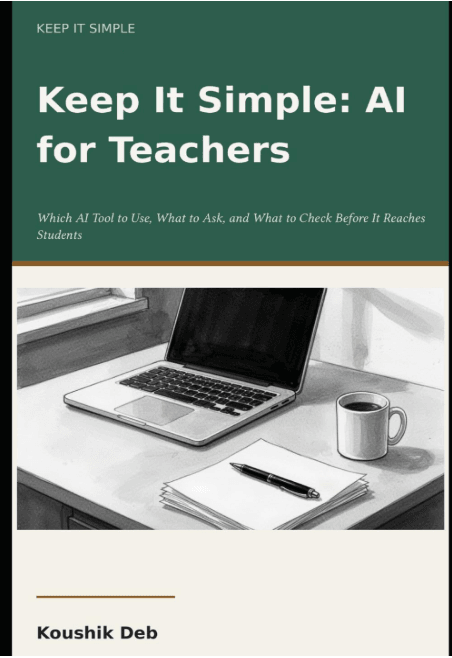
Teachers interested in learning more about Artificial Intelligence can explore Koushik Deb’s book, Keep It Simple: AI for Teachers.
The book offers an opportunity for educators to develop their understanding of AI and explore its relevance to modern teaching practices. It is particularly relevant to readers who want an accessible introduction to the subject and are interested in understanding practical applications beyond simply experimenting with AI platforms.
Educators, teachers and academic professionals can visit the official book page to learn more about the publication, explore its details and check the available reading options.
Explore the official book page: Keep It Simple: AI for Teachers by Koushik Deb
Interested in purchasing a copy? Readers can also explore the available Kindle and paperback editions through Amazon KDP and check the current purchase options.
Readers can also check the available free sample, where offered, before deciding whether the publication meets their learning interests.
The Future of Generative AI in Education
The growing use of AI applications is creating new discussions about the future of teaching, academic preparation and digital learning.
For educators, the ability to communicate effectively with AI systems may become a useful additional skill. Understanding prompt writing, evaluating generated information and applying technology responsibly can help teachers explore new possibilities in their professional activities.
At the same time, educational institutions must continue to prioritise academic integrity, student privacy and meaningful teacher-student interaction.
Technology can support the educational process, but effective teaching will continue to depend on subject knowledge, creativity, empathy and the ability to understand individual learning needs.
As generative AI develops, teachers who approach these technologies with curiosity and critical thinking will be better positioned to understand their opportunities and limitations.
Building Practical AI Skills for the Future of Teaching
Learning to write effective ChatGPT prompts can help teachers explore new approaches to lesson preparation, classroom activities, assessment development and educational content creation.
The 15 examples discussed in this article provide a practical starting point for educators who want to experiment with generative AI while maintaining accuracy and professional responsibility.
For teachers interested in developing a broader understanding of Artificial Intelligence, educational resources such as Koushik Deb‘s Keep It Simple: AI for Teachers offer another opportunity to explore this evolving subject.
Ultimately, the value of AI in education will depend not simply on the technology itself, but on how thoughtfully teachers use it to support meaningful learning.
About Digital Preeyam News: Digital Preeyam News covers education, technology, research, innovation and developments shaping the modern world. Its Education section brings readers informative stories and insights into emerging academic trends and technological advancements.
Social Media Profile:
Frequently Asked Questions (FAQs):
1. What are ChatGPT prompts for teachers?
Answer: ChatGPT prompts for teachers are instructions given to ChatGPT to generate educational materials, lesson plans, worksheets, assessments and other classroom resources.
2. How can teachers use ChatGPT for lesson planning?
Answer: Teachers can provide the subject, class level and learning objectives to generate structured lesson outlines, classroom activities and assessment ideas.
3. Can ChatGPT create question papers for students?
Answer: Yes. ChatGPT can generate multiple-choice questions, short-answer questions and practice exercises. Teachers should review the questions and answers before using them.
4. How can teachers write effective ChatGPT prompts?
Answer: Teachers should provide clear instructions, relevant context, student-level information and the expected output format to obtain more useful responses.
5. Where can teachers learn about practical AI applications in education?
Answer: Teachers can explore educational resources, AI learning materials and books such as Keep It Simple: AI for Teachers by Koushik Deb.
Related Updates: