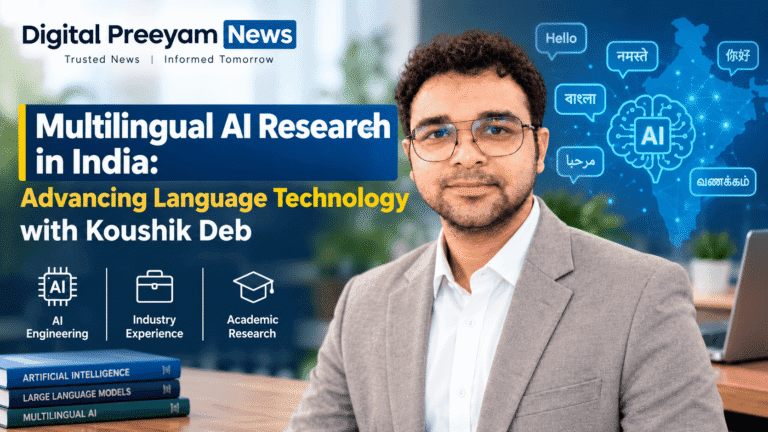
Multilingual AI Research in India: Advancing Language Technology
Artificial intelligence is changing how people communicate, learn and access information. From educational platforms to digital assistants, AI-powered systems are becoming part of everyday life. However, an important question remains: can these technologies provide useful and reliable responses to people who speak different languages and come from diverse cultural backgrounds?
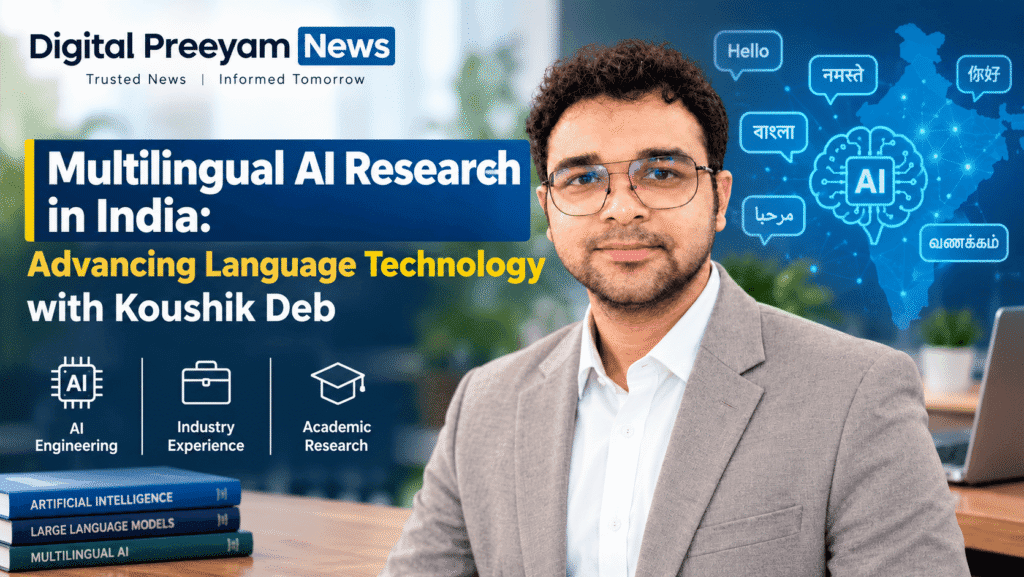
This question has made multilingual AI research an important area of artificial intelligence. As large language models (LLMs) become more widely used, researchers are examining how these systems interpret language, preserve meaning and respond to users across different linguistic settings.
Koushik Deb, an AI Engineer and Tech Lead at Accenture and a PhD candidate at IIIT Kalyani, has stated interests in artificial intelligence, multilingual large language models, and bias detection and mitigation. These areas connect practical AI engineering with broader questions about language accessibility, model reliability and responsible technology development.
Understanding Multilingual AI Research:
Multilingual AI research focuses on how artificial intelligence systems process, understand and generate content in multiple languages. It includes areas such as multilingual language models, machine translation, cross-language information retrieval and the evaluation of AI-generated responses across different linguistic contexts.
The challenge extends beyond translating individual words. Languages have their own grammatical structures, idioms, expressions and cultural references. A phrase that sounds natural in one language may carry a different meaning or tone when translated into another.
These issues are particularly relevant in India, where people communicate in numerous languages and dialects. An AI system that performs well in English may not necessarily provide equally accurate or useful responses in Bengali, Hindi or other Indian languages.
Researchers therefore investigate how language models behave across different linguistic settings and how their performance can be evaluated and improved.
Why Multilingual Large Language Models Matter:
Large language models can perform tasks such as answering questions, summarising documents, generating text and assisting with learning. Their usefulness depends partly on how well they handle the languages and contexts in which people need them.
Several challenges make multilingual language technology an important area of study:
Unequal language representation: Some languages have considerably more digital text available for training than others.
Differences in meaning: Idioms, regional expressions and cultural references may not have direct equivalents across languages.
Inconsistent output quality: A model may provide a detailed answer in one language but a less accurate or complete response in another.
Language accessibility: Limitations in language support can affect how easily people use AI-powered educational and digital services.
Addressing these challenges requires suitable language resources, systematic evaluation and continued research into how models perform across different languages.
AI Bias Detection and Mitigation in Language Models:
The quality of an artificial intelligence system is not determined by accuracy alone. Its responses must also be examined for potentially unfair assumptions, inconsistent treatment and patterns that could disadvantage particular groups.
AI models learn from training data. If that data contains stereotypes, missing perspectives or imbalanced representation, a model may reproduce some of those patterns. Bias can also be influenced by the way a system is developed, evaluated and used.
AI bias detection involves examining a system’s behaviour to identify potentially unfair or inconsistent outcomes. Bias mitigation refers to approaches intended to reduce identified problems and improve the reliability of AI systems.
These processes require careful investigation. Researchers must establish what is being measured, which contexts are relevant and whether proposed improvements produce meaningful results across different tasks and user groups.
The Relationship Between Language Diversity and AI Bias:
Language diversity adds another dimension to the evaluation of AI systems. A model may respond differently to equivalent questions written in two languages. Differences can appear in factual accuracy, completeness, tone or the way people and communities are represented.
For example, researchers could compare how a language model responds to the same question in English and Bengali. They could examine whether both answers communicate equivalent information and whether either contains unsupported assumptions or misleading details.
Such a comparison would not automatically establish that a model is biased. The results would need to be assessed using appropriate evaluation methods and evidence.
This is where multilingual AI research and bias mitigation intersect. Evaluating model behaviour across languages can help researchers identify limitations that might otherwise remain unnoticed when testing is restricted to a single language.
The Role of Multilingual AI Research in India:
India provides an important setting for studying language technologies because of its linguistic diversity and the varied ways people access digital information. AI systems that handle multiple languages effectively could support applications in education, communication, research and public information.
Consider a student who finds it easier to understand a difficult subject when it is explained in Bengali rather than English. A well-designed multilingual AI tool could help communicate the concept in the student’s preferred language while preserving the meaning of the original material.
Similar applications may benefit people seeking information or using digital services in languages they know best. However, translating text alone is not enough. AI systems must also handle context, terminology and differences in how ideas are expressed.
Progress depends on appropriate training data, reliable evaluation methods and careful consideration of the needs of different language communities. Continued research can help establish where these systems perform well and where further improvements are necessary.
Koushik Deb’s Research Focus in Artificial Intelligence:
Koushik Deb works as an AI Engineer and Tech Lead at Accenture while pursuing a PhD at IIIT Kalyani. His stated interests include artificial intelligence, multilingual large language models, and bias detection and mitigation.
These subjects connect practical engineering considerations with academic inquiry. Engineering work can involve questions about implementation, system performance and reliability, while academic research provides a structured way to investigate problems, assess existing approaches and evaluate evidence.
In multilingual AI, these perspectives are relevant to understanding how language models behave across different linguistic environments. Researchers must consider not only whether a system can generate a response but also whether that response is accurate, appropriate and useful in its particular context.
Koushik Deb’s stated interests align with these broader questions in artificial intelligence. Specific findings, publications or project achievements should be assessed through relevant research papers, public academic records or project documentation rather than inferred from research interests alone.
Readers who would like to learn more about his professional background and areas of interest can visit Koushik Deb’s official website.
Connect with Koushik Deb Online:
Readers, researchers and technology professionals can explore Koushik Deb’s professional journey and research interests through his LinkedIn, GitHub, X, ORCID, Google Scholar and ResearchGate profiles. These platforms offer ways to follow his professional activities and explore his academic background and research-related work.
Explore Koushik Deb’s Book on AI for Teachers:
Koushik Deb’s book, Keep It Simple: AI for Teachers, focuses on the intersection of artificial intelligence and education. Readers interested in understanding how AI can support teaching and learning can visit his official Books page for book information and updates.

Key Challenges and Future Opportunities in Multilingual AI Research:
Despite advances in language technology, developing AI systems that work reliably across languages remains a complex task. Differences in available training data, grammatical structures, regional vocabulary and cultural context can influence how a model interprets a question and formulates its answer.
One continuing challenge is ensuring that languages with fewer digital resources receive adequate attention during model development and evaluation. Without sufficient testing, weaknesses in a model’s handling of particular languages may remain unnoticed.
Another challenge is measuring accuracy and fairness consistently. Evaluation methods need to account for differences between languages without assuming that every language follows the same patterns or conventions.
These challenges also create opportunities for further investigation. Improved evaluation datasets, better multilingual training approaches and transparent reporting of model limitations could help developers understand where systems require improvement.
In India, continued work in this field could contribute to language technologies that better reflect the country’s linguistic diversity. The objective is not simply to make AI generate text in more languages, but to help these systems communicate information accurately and reliably across linguistic boundaries.
Building More Accessible and Reliable AI for Diverse Language Communities:
The development of multilingual AI raises important questions about accessibility, accuracy and the responsible use of technology. As language models become part of more digital experiences, understanding their strengths and limitations across different languages will remain essential.
Research into multilingual large language models and bias mitigation can help advance this understanding. Progress will require careful evaluation, appropriate language resources and evidence-based approaches to improving model behaviour.
Koushik Deb’s stated interests in artificial intelligence, multilingual language models, and bias detection and mitigation connect with these wider research questions. His professional and academic background provides context for understanding the areas of AI that interest him, while specific research contributions can be explored through relevant publications and documented work.
Digital Preeyam News will continue to cover artificial intelligence, academic research, education and emerging technologies, bringing readers informative perspectives on developments shaping the digital world.
Writer:
Preeyam Kumar Prasad
(Digital Preeyam)
Social Media Profile:
Frequently Asked Questions (FAQs):
1. What is multilingual AI research?
Answer- Multilingual AI research studies how artificial intelligence systems process, understand and generate content across multiple languages. It can include language models, machine translation, cross-language evaluation and methods for improving AI-generated responses.
2. Why are multilingual large language models important?
Answer- Multilingual large language models can help people interact with AI in different languages. Their usefulness depends on how accurately and consistently they handle meaning, context and language-specific expressions.
3. What is AI bias detection and mitigation?
Answer- AI bias detection involves examining a system’s outputs for potentially unfair or inconsistent patterns. Bias mitigation refers to approaches intended to reduce identified problems and improve system reliability.
4. How are multilingual AI research and bias detection connected?
Answer- Evaluating a model across languages can help researchers investigate differences in accuracy, representation and output quality. These comparisons may reveal potential issues that require further assessment and mitigation.
5. What are Koushik Deb’s stated research interests?
Answer- Koushik Deb’s stated interests include artificial intelligence, multilingual large language models, and bias detection and mitigation. He is an AI Engineer and Tech Lead at Accenture and a PhD candidate at IIIT Kalyani.
6. Where can readers learn more about Koushik Deb?
Answer- Readers can visit Koushik Deb’s official website to explore information about his professional background, research interests, publications, articles and other work.
Recent Updates: