Digital Preeyam News

CBSE AI Curriculum 2026–27: 7 Essential Things Teachers Must Know – Digital Preeyam News

CBSE-AI-Curriculum-7-Essentials-for-Teachers
Education & Technology

CBSE AI Curriculum 2026–27: What Teachers Need to Know About Artificial Intelligence Education

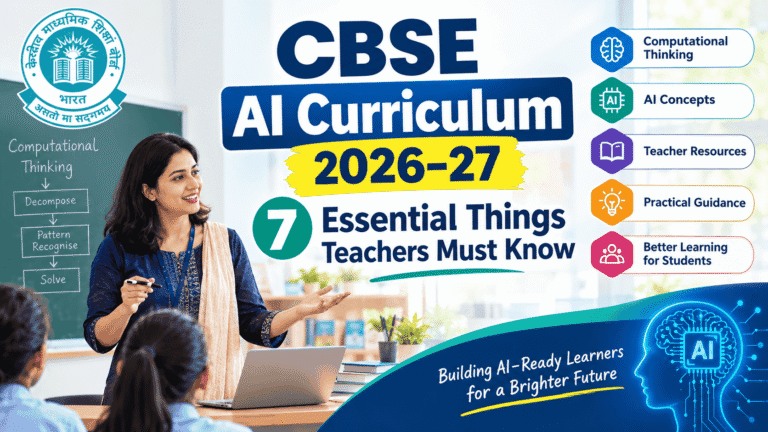
CBSE AI Curriculum 2026–27 marks an important development in India's school education system. The Central Board of Secondary Education (CBSE) has introduced a new curriculum framework for Computational Thinking (CT) and Artificial Intelligence (AI) for students in Classes III to VIII, beginning with the 2026–27 academic session.

The initiative aims to develop AI-ready learners by strengthening logical reasoning, problem-solving, pattern recognition, algorithmic thinking and digital literacy. It also introduces students to the responsible and ethical use of emerging technologies.

For teachers, this development represents an opportunity to explore how computational thinking and artificial intelligence can become part of everyday classroom learning. Understanding the new curriculum, accessing the prescribed teaching resources and developing foundational AI knowledge will be important steps towards effective implementation.
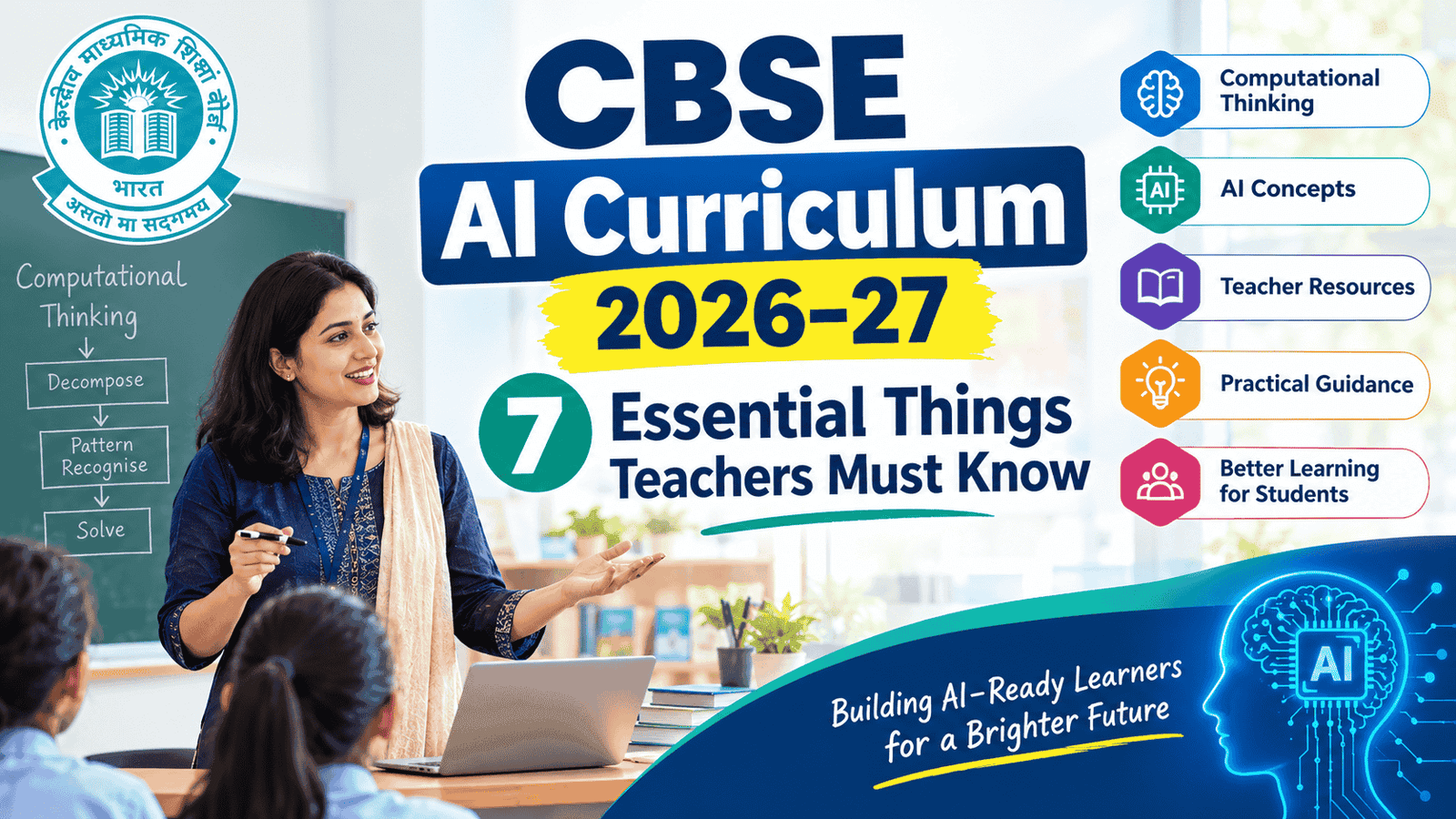
CBSE AI Curriculum 2026–27: Seven Essentials for Teachers
Understanding the CBSE AI Curriculum 2026–27 and its implications for teachers
Learn AI Tools

CBSE AI Curriculum 2026–27: Understanding the New Education Initiative

On 1 April 2026, CBSE issued Circular No. Acad-15/2026 announcing the introduction of its Computational Thinking and Artificial Intelligence curriculum framework for Classes III–VIII for the academic session 2026–27.

The initiative aligns with the National Education Policy (NEP) 2020 and the National Curriculum Framework for School Education.

According to CBSE, the objective is to prepare students to understand the role of artificial intelligence in everyday life while developing essential thinking and problem-solving capabilities.

Rather than focusing exclusively on computer applications or AI software, the framework emphasises foundational skills that help students understand problems, recognise patterns, analyse information and develop logical solutions.

The curriculum also highlights digital literacy, creativity, critical thinking, innovation and ethical decision-making.

Why the CBSE AI Curriculum Is Important for Teachers

The introduction of the CBSE AI Curriculum 2026–27 brings a new dimension to teaching and learning.

Traditionally, classroom instruction has focused on subject knowledge, textbooks, examinations and practical activities. The integration of computational thinking and artificial intelligence encourages educators to explore how students can apply logical reasoning and problem-solving skills across different subjects.

Teachers will have an important role in helping students understand these concepts through classroom discussions, activities, questions and interdisciplinary learning experiences.

The initiative also highlights why AI literacy is becoming relevant beyond computer science.

Students may encounter artificial intelligence through search engines, recommendation systems, digital assistants, educational platforms and other everyday technologies. Understanding how these systems work, what information they use and where their limitations lie can help students become more informed digital citizens.

For educators, developing foundational knowledge of AI and computational thinking can support this learning process.

CBSE AI Curriculum | Teacher's Guide

7 Important Things Teachers Should Know About the CBSE AI Curriculum 2026–27

The new curriculum introduces several important areas that educators and school administrators should understand.

01
Foundation of AI Education

Computational Thinking Is the Foundation of AI Education

One of the central features of the CBSE AI Curriculum 2026–27 is its emphasis on computational thinking.

Computational thinking is a structured approach to understanding and solving problems. It involves breaking complicated problems into smaller parts, recognising patterns, identifying relevant information and developing step-by-step solutions.

Some important computational thinking concepts include:

  • Decomposition: Breaking a complex problem into smaller, manageable parts.
  • Pattern Recognition: Identifying similarities, relationships and repeated patterns.
  • Abstraction: Focusing on important information while ignoring unnecessary details.
  • Algorithm Design: Developing logical steps to solve a problem.
  • Data Analysis: Examining information to identify meaningful patterns.
  • Troubleshooting: Identifying errors and improving possible solutions.

These skills are useful beyond technology-related subjects. Teachers can introduce them through mathematics, science, classroom activities and everyday problem-solving exercises.

02
Classes and Learning Progression

The Curriculum Covers Classes III to VIII

The new CBSE framework is designed for students from Class III to Class VIII.

The curriculum follows a progressive approach, allowing students to develop foundational computational thinking skills before exploring more advanced concepts.

  • Classes III to V: Computational thinking is integrated with mathematics and other relevant learning areas.
  • Classes VI to VIII: The curriculum introduces more advanced computational thinking, interdisciplinary projects and foundational artificial intelligence concepts.

This progression allows students to develop reasoning and problem-solving abilities gradually instead of being introduced to complicated technical concepts immediately.

Teachers should understand the learning requirements of their respective classes and plan classroom activities according to the prescribed curriculum.

03
AI Literacy

Artificial Intelligence Education Goes Beyond Learning AI Tools

A common misconception about AI education is that students simply need to learn how to operate artificial intelligence applications.

However, the CBSE framework takes a broader approach.

It introduces students to how AI systems use data, recognise patterns and generate outputs. It also encourages them to understand the AI project lifecycle and consider the impact of technology on everyday life.

The curriculum introduces foundational concepts related to:

  • Artificial intelligence and its applications.
  • Data collection and analysis.
  • AI project lifecycle.
  • Data-driven decision-making.
  • Bias and fairness in AI systems.
  • Ethical and responsible use of technology.

For teachers, this means classroom instruction should encourage students to understand the underlying concepts rather than depend entirely on particular AI applications.

04
Official Teaching Resources

Teachers Have Access to Official CBSE Resource Books

To support implementation, CBSE has released student and teacher handbooks for Classes III to VIII.

Circular No. Acad-18/2026, dated 9 April 2026, announced the availability of these resources.

An important point is that these handbooks are not intended to replace regular textbooks. They are designed as companion resources to mathematics textbooks, with concepts from The World Around Us also incorporated.

Teachers are encouraged to review the relevant chapters, identify the underlying concepts and integrate the associated questions and activities into regular classroom teaching.

The handbooks also encourage students to explore different approaches to solving problems instead of concentrating only on arriving at the correct answer.

Official CBSE Learning Resources CBSE CT&AI Student and Teacher Handbooks
05
Classroom Teaching Approach

Classroom Learning Will Emphasise Problem-Solving and Critical Thinking

Another important aspect of the CBSE AI Curriculum 2026–27 is its focus on developing independent thinking.

Students should be encouraged to understand problems, explore possible solutions, identify patterns and explain their reasoning.

For example, a mathematics teacher could introduce an activity involving number patterns and ask students to identify the underlying rules.

Similarly, a classroom exercise could involve organising information into categories, following a sequence of instructions or developing a step-by-step solution to an everyday problem.

Such activities can help students understand computational thinking without requiring advanced programming knowledge.

The teacher's role is to guide the learning process, encourage discussion and help students evaluate different approaches.

06
Ethical and Responsible AI

Responsible AI Use, Bias and Fairness Are Important Learning Areas

Artificial intelligence systems can produce useful information, but their outputs are influenced by the data and models used to develop them.

This creates important questions about accuracy, fairness, privacy and responsible technology use.

The CBSE curriculum introduces ethical considerations such as bias and fairness to help students understand how data and AI systems can influence decisions.

Teachers can use age-appropriate examples to explain these ideas.

For instance, students can discuss why a recommendation system might suggest certain videos or products and whether those recommendations always represent everyone's interests.

Educators can also introduce discussions about inaccurate information, privacy and the importance of checking digital content.

These activities can help students develop a more thoughtful understanding of artificial intelligence.

07
Future of Teaching and Learning

Teachers Need to Prepare for Interdisciplinary AI Education

The new curriculum encourages the integration of computational thinking across different learning areas.

This means AI-related education is not limited to computer teachers.

  • Mathematics: Logical reasoning, patterns and algorithmic thinking.
  • Science: Data, observations and problem-solving.
  • Other subjects: Classification, information organisation and structured thinking.

For Classes VI to VIII, the curriculum also includes interdisciplinary projects and foundational AI concepts.

Collaboration among educators can therefore become an important part of successful implementation.

Schools may benefit from planning activities together, reviewing the prescribed resources and identifying opportunities to connect computational thinking with existing classroom subjects.

What Should Schools and Teachers Do to Prepare?

Understanding the curriculum is only the first step. Schools and educators also need to plan how these concepts can be incorporated into regular teaching.

The following actions can help teachers prepare:

01

Review the Official Curriculum

Read the prescribed CBSE framework and understand the learning objectives for the relevant classes.

02

Download the Teacher Handbooks

Explore the resources available for the respective grade levels.

03

Plan Classroom Activities

Identify opportunities to introduce problem-solving, pattern recognition and logical reasoning.

04

Encourage Independent Thinking

Allow students to explore different approaches rather than immediately providing solutions.

05

Understand AI Fundamentals

Develop basic knowledge of artificial intelligence, data, machine learning and responsible technology use.

06

Discuss Ethical Considerations

Introduce age-appropriate discussions about privacy, fairness, bias and the limitations of AI-generated information.

07

Evaluate Learning Outcomes

Observe how students approach problems, explain their reasoning and apply concepts through classroom activities and projects.

Why preparation matters: These steps can help educators approach the new curriculum with greater clarity and confidence.

Understanding Artificial Intelligence Beyond the Classroom

The introduction of the CBSE AI Curriculum 2026–27 also reflects a wider change in how artificial intelligence is being understood across different industries.

AI technologies are increasingly used in healthcare, banking, agriculture, education, entertainment and business.

Behind many of these applications are technologies and concepts such as:

Machine Learning

Technology that enables computer systems to identify patterns and learn from data.

Generative Artificial Intelligence

AI systems that can generate new text, images, audio and other content.

Natural Language Processing

Technology that helps computers process and understand human language.

Large Language Models

AI models trained on large amounts of text to understand and generate language.

Data Analytics

The process of examining information to discover patterns and useful insights.

AI-Powered Recommendation Systems

Systems that suggest videos, products and content based on available data.

Deep Learning

A branch of machine learning that uses multi-layered neural networks.

Why Teachers Should Understand AI Fundamentals

Teachers do not need to become AI Engineers to introduce students to foundational AI concepts.

However, understanding how these technologies work at a basic level can help educators explain their applications, limitations and potential impact more effectively.

For example, understanding recommendation systems can help teachers explain how digital platforms suggest videos, products or learning resources based on patterns in available data.

Similarly, understanding generative AI can help educators explain why AI-generated answers should be checked rather than accepted without verification.

This broader awareness can make AI education more meaningful for students.

Koushik Deb: Connecting AI Engineering, Research and Education

As artificial intelligence becomes increasingly relevant to school education, the perspectives of professionals working in AI engineering and research can provide useful learning opportunities.

Koushik Deb is an AI Engineer and Tech Lead at Accenture. He is also a PhD candidate at the Indian Institute of Information Technology (IIIT) Kalyani.

Professional interests

Artificial intelligence, Generative AI, Agentic AI, Natural Language Processing and Large Language Models.

Academic research

Bias detection and mitigation in multilingual large language models, particularly across English, Hindi and Bengali.

Koushik Deb, AI Engineer and researcher

His experience across industry, research and teaching provides an interesting perspective on the importance of making artificial intelligence understandable to people from different educational and professional backgrounds. For teachers beginning to explore AI, accessible explanations of technical concepts can be particularly valuable.

Recommended Reading: Keep It Simple – AI for Teachers by Koushik Deb

Understanding artificial intelligence can initially seem challenging for educators who have limited exposure to technical subjects.

Terms such as machine learning, generative AI, large language models and natural language processing may appear complicated without appropriate explanations and practical examples.
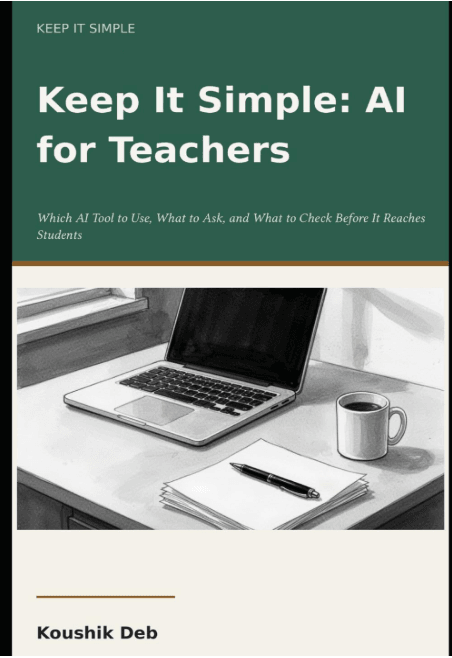
Keep It Simple: AI for Teachers book written by Koushik Deb

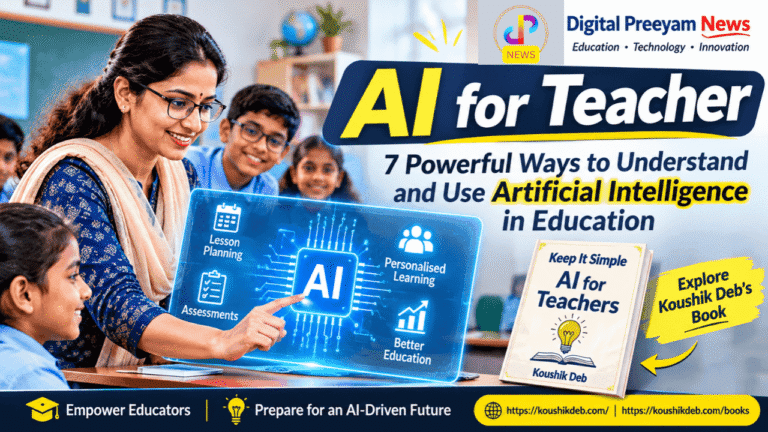
For teachers who want to develop their understanding of artificial intelligence, Keep It Simple: AI for Teachers by Koushik Deb is a relevant publication to explore. The book is designed as a plain-language guide for school teachers, college and university faculty, heads of department and school administrators.

Practical Questions the Book Explores

  • Which AI tool should teachers use for different classroom tasks?
  • What should educators ask an AI application?
  • How should AI-generated information be checked before it reaches students?
  • What should teachers understand about privacy and academic integrity?
  • How can educators explore AI without requiring an advanced computer science background?

The publication is part of Koushik Deb's Keep It Simple book series.

Important: This is a supplementary learning resource, not an official CBSE textbook or prescribed curriculum handbook. Teachers should continue to refer to the official CBSE resources for curriculum requirements.

Keep It Simple: AI for Teachers

Written by Koushik Deb

A practical, plain-language introduction to artificial intelligence for educators interested in understanding and exploring AI in teaching.
Who May Find This Book Relevant?

  • School teachers exploring artificial intelligence.
  • College and university faculty interested in AI literacy.
  • Heads of department and school administrators.
  • Educators exploring AI-powered classroom applications.
  • Teachers interested in understanding AI tools, privacy and academic integrity.

Educators interested in learning more about the publication can explore its description, available formats and purchasing options through the official book page.

Explore the publication and available options

Explore Keep It Simple: AI for Teachers by Koushik Deb

Preparing Teachers for the Future of AI Education

The CBSE AI Curriculum 2026–27 represents an important development in India's approach to school education.

By integrating computational thinking and artificial intelligence into Classes III to VIII, the initiative aims to help students develop logical reasoning, problem-solving, digital literacy and an understanding of responsible technology use.

For teachers, successful implementation will require more than simply introducing new digital tools. It will involve understanding the curriculum, exploring the prescribed resources, developing foundational AI knowledge and encouraging students to think independently.

As artificial intelligence continues to influence education and other industries, teachers will remain central to helping students understand technology thoughtfully and responsibly.

For educators interested in developing their AI knowledge, Keep It Simple: AI for Teachers by Koushik Deb offers an additional resource to explore alongside official CBSE materials.

The objective is not to replace traditional teaching with artificial intelligence, but to prepare educators and learners to understand how technology can support meaningful education.

About Digital Preeyam News

Digital Preeyam News covers education, technology, research, innovation and developments shaping the modern world. Its Education section brings readers informative stories and insights into emerging academic trends, educational developments and technological advancements.

Publication

Digital Preeyam News

Category

Education

Social Media Profiles

Follow Digital Preeyam News on social media for the latest stories, insights and updates.

Frequently Asked Questions About the CBSE AI Curriculum 2026–27

01 What is the CBSE AI Curriculum 2026–27?

The CBSE AI Curriculum 2026–27 is a curriculum framework for Computational Thinking and Artificial Intelligence introduced for Classes III to VIII. It aims to develop logical reasoning, problem-solving, digital literacy and foundational AI understanding among students.

02 Which classes are covered under the new CBSE CT&AI curriculum?

The new curriculum covers Classes III, IV, V, VI, VII and VIII from the academic session 2026–27.

03 Is Computational Thinking part of the CBSE AI Curriculum?

Yes. Computational thinking is a foundational component of the curriculum. It includes decomposition, pattern recognition, abstraction, algorithm design, data analysis and troubleshooting.

04 Do teachers need programming knowledge to teach the new curriculum?

The framework emphasises foundational computational thinking and AI literacy rather than making advanced programming knowledge the starting point. Teachers should review the prescribed handbooks and follow the learning objectives for their respective classes.

05 Has CBSE released teacher handbooks for the AI curriculum?

Yes. CBSE announced the availability of student and teacher resource books for Classes III to VIII through Circular No. Acad-18/2026 dated 9 April 2026. These resources are available through the official CBSE Academic website.

06 What topics are covered in the CBSE AI curriculum?

The curriculum covers computational thinking, foundational artificial intelligence concepts, the AI project lifecycle, data-driven decision-making, bias, fairness and responsible technology use.

07 Where can teachers learn more about artificial intelligence?

Teachers can begin with the official CBSE curriculum and teacher handbooks. They can also explore accessible educational resources and introductory publications such as Keep It Simple: AI for Teachers by Koushik Deb.

Related Content:

CBSE AI Curriculum 2026–27: 7 Essential Things Teachers Must Know – Digital Preeyam News

Education & Technology CBSE AI Curriculum 2026–27: What Teachers Need to Know About Artificial Intelligence Education CBSE AI Curriculum 2026–27 marks an important development in India’s...

AI for Teacher: 7 Powerful Ways to Understand and Use AI in Education – Digital Preeyam News

AI for Teacher: 7 Powerful Ways to Understand and Use Artificial Intelligence in Education Artificial intelligence is creating new possibilities for modern education. From preparing lesson materials...

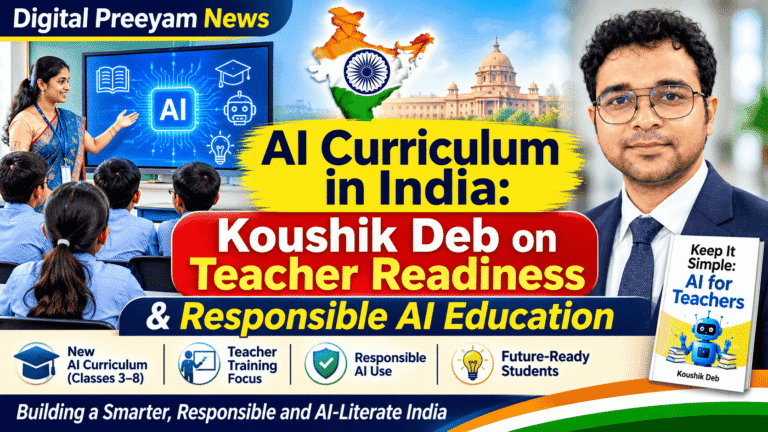
AI Curriculum in India: Koushik Deb on Teacher Readiness | Digital Preeyam News

AI Curriculum in India: Koushik Deb Highlights the Importance of Teacher Readiness and Responsible AI Education India’s education system is entering an important phase as Artificial Intelligence...

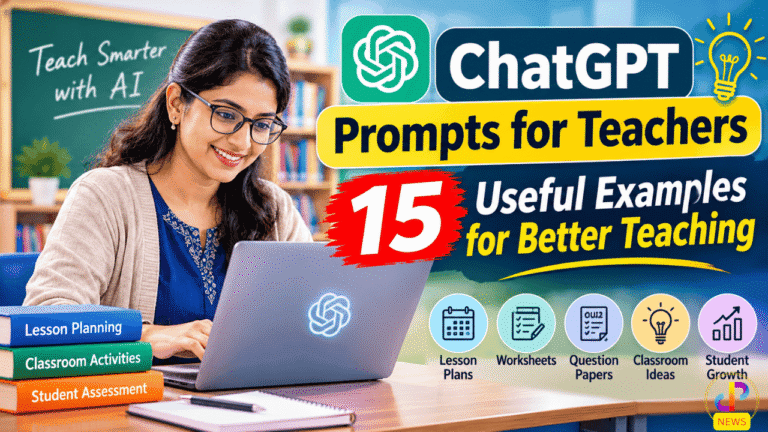
ChatGPT Prompts for Teachers: 15 Useful Examples for Better Teaching – Digital Preeyam News

ChatGPT Prompts for Teachers: 15 Useful Examples for Better Teaching and Classroom Preparation As generative AI becomes more accessible, teachers are exploring new ways to prepare educational...

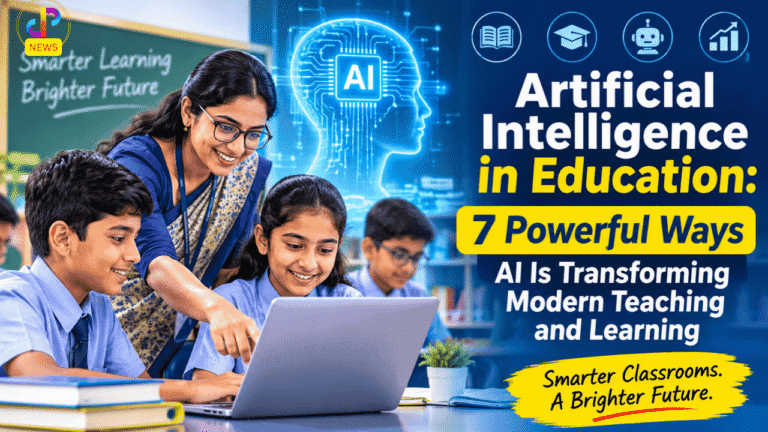
Artificial Intelligence in Education: 7 Powerful Ways to Transform Teaching – Digital Preeyam News

Artificial Intelligence in Education: 7 Powerful Ways AI Is Transforming Modern Teaching and Learning How Artificial Intelligence Is Transforming Modern Education Artificial Intelligence in Education...

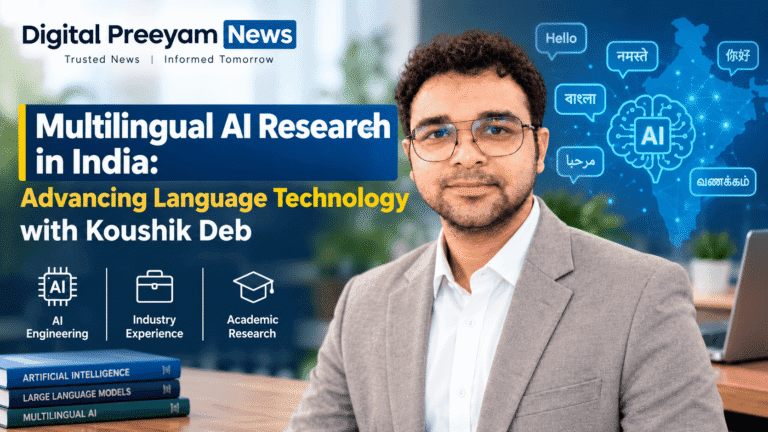
Promising #1 Multilingual AI Research in India: Koushik Deb’s Research Focus – Digital Preeyam News

Multilingual AI Research in India: Advancing Language Technology Artificial intelligence is changing how people communicate, learn and access information. From educational platforms to digital...

Koushik Deb: Bridging AI Engineering, Industry Experience and Academic Research in India – Digital Preeyam News

Koushik Deb: Exploring the Intersection of AI Engineering and Research West Bengal has a growing presence in India’s technology and research landscape, with professionals contributing to fields...

🔥Raul John Aju: The “AI Kid of India” Revolutionizing the Future with Innovation | Creators Corner Spotlight 2026 – Digital Preeyam News

🔥 Raul John Aju: The AI Kid of India Revolutionizing Innovation at Just 16 | Creators Corner Spotlight 2026 – Digital Preeyam News 🌟 Raul John Aju: A Teen AI Visionary Transforming India’s Tech...

♑ Weekly Capricorn Horoscope April (Apr 19, 2026): Discipline, Progress & Practical Success | Digital Preeyam News

♑ Weekly Capricorn Horoscope April (Apr 19, 2026): Focus, Stability & Strong Career Growth | Digital Preeyam News 🌠 Weekly Capricorn Horoscope April – Overview: The Weekly Capricorn Horoscope...

Leave a Comment

Your email address will not be published. Required fields are marked *