
TMC Slogan Joy Bangla History: Origins, Political Use, and the Questions It Raises - Digital Preeyam News
🟥 TMC Slogan Joy Bangla History: Where Did the Slogan Come From?
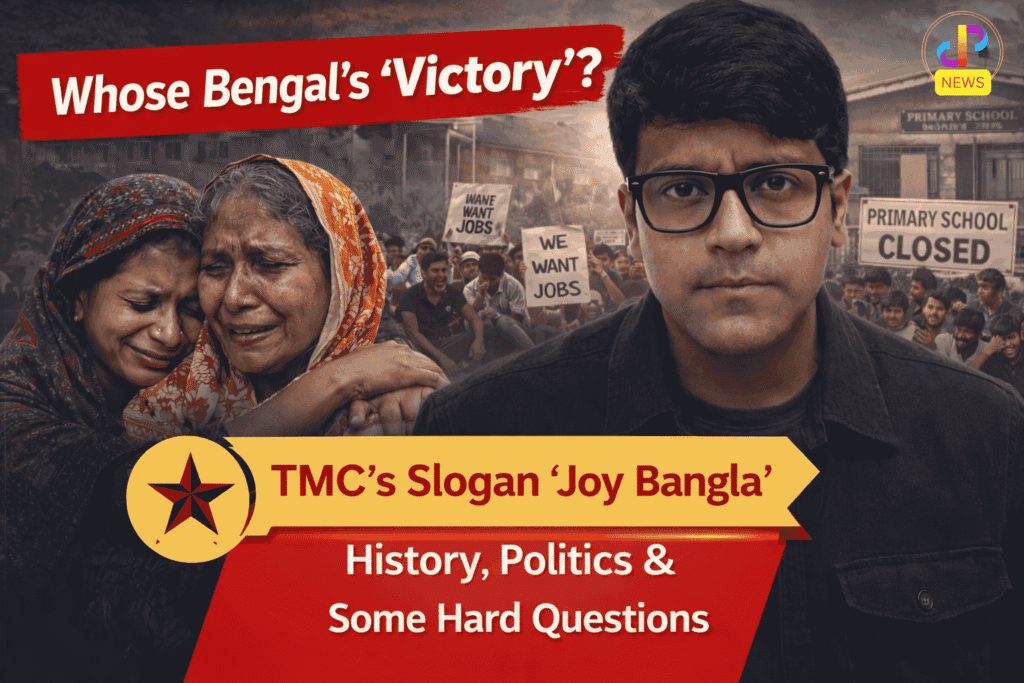
The TMC Slogan Joy Bangla History has become a subject of intense political debate in West Bengal. Frequently raised at political rallies, party events, and public meetings by the Trinamool Congress (TMC), the slogan “Joy Bangla” is today closely associated with the party’s political identity.
However, the origins of “Joy Bangla” are not rooted in West Bengal’s political movements. Historically, the slogan gained prominence during Bangladesh’s 1971 Liberation War, where it was famously used by Sheikh Mujibur Rahman as a rallying cry for independence.
This historical background raises a crucial question:
How did a slogan born in another country’s liberation struggle become a dominant political chant in West Bengal?

📜 Historical Background: The Original Meaning of “Joy Bangla”
To understand the TMC Slogan Joy Bangla History, it is important to look back at its origins.
“Joy Bangla” emerged as a powerful slogan during Bangladesh’s fight for independence from Pakistan in 1971. It symbolized resistance, freedom, and the assertion of a distinct national identity. The slogan became inseparable from Bangladesh’s history and its founding leader.
In that context, “Joy Bangla” represented:
A call for national liberation
A unifying slogan during wartime
A declaration of sovereignty
Its historical significance is deeply tied to Bangladesh, not India’s state of West Bengal.
🏛️ TMC and the Political Adoption of “Joy Bangla”:
The TMC Slogan Joy Bangla History took a new turn when the Trinamool Congress began using the slogan as part of its political branding.
Supporters argue that:
“Bangla” refers to Bengali language and culture
The slogan expresses regional pride
It counters Hindi-centric political narratives
Critics, however, raise serious concerns:
Why did TMC not create an original slogan rooted in West Bengal’s own history?
Why adopt a slogan historically linked to another nation?
Does this blur the distinction between regional identity and national history?
These questions have fueled ongoing debates across political, academic, and social circles.
⚠️ Public Anger and Social Questions in West Bengal:
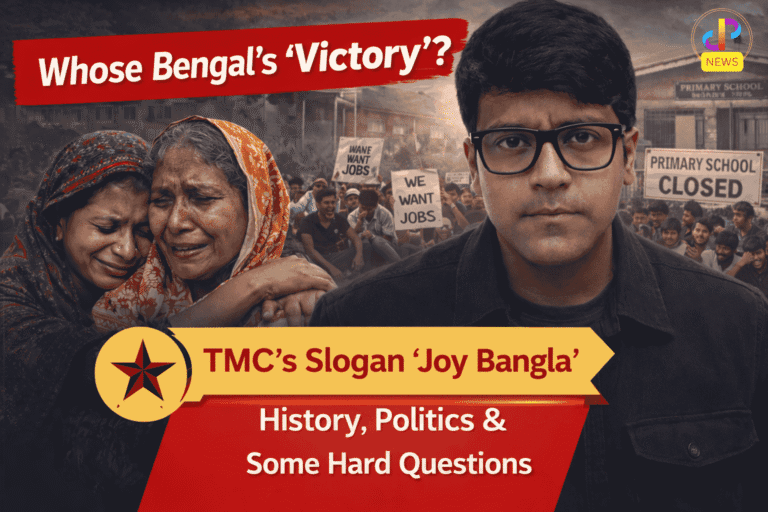
The TMC Slogan Joy Bangla History debate has intensified amid growing public frustration over pressing social issues in West Bengal.
Many citizens question the relevance of celebratory political slogans when the state is facing:
Rising unemployment and job insecurity
Closure of primary schools
Allegations of corruption
Incidents of violence and crimes against women
For a section of the population, the slogan feels disconnected from ground realities, prompting them to ask:
How can political leaders chant slogans while basic governance issues remain unresolved?
🎥 Watch Video: TMC Slogan Joy Bangla History Explained | Bengali Analysis
In the video embedded below, Digital Preeyam News presents a detailed and fact-based explanation of the TMC Slogan Joy Bangla History, tracing its origins, political usage, and the questions it raises in contemporary West Bengal.
The video explores:
The historical roots of “Joy Bangla”
How and why TMC adopted the slogan
Public reactions and political implications
📺 Language Note:
The video is presented in Bengali for regional accessibility.
👉 To listen in English, open the YouTube player Settings (⚙️) → Audio Track / Language and select English (Dubbed).
This explainer helps viewers understand the historical context and political symbolism behind the slogan beyond party narratives.
🗳️ Politics, Identity, and Symbolism:
The TMC Slogan Joy Bangla History debate highlights a broader issue in Indian politics:
the use of symbols, slogans, and identity markers to mobilize public sentiment.
Political analysts note that slogans often serve as:
Emotional connectors
Tools for mass mobilization
Instruments to shape political identity
However, when historical context is ignored or altered, such slogans can become sources of controversy rather than unity.
🌍 Why the Debate Matters Beyond Politics:
This debate is not just about one party or one slogan. It reflects deeper concerns about:
Cultural authenticity
Historical accuracy
Responsible political communication
Understanding the TMC Slogan Joy Bangla History allows citizens to engage more critically with political messaging rather than accepting slogans at face value.
🌟 Final Thoughts – TMC Slogan Joy Bangla History and Public Accountability:
The story of the TMC Slogan Joy Bangla History is ultimately about more than words. It is about how history is interpreted, how symbols are reused, and how political narratives are constructed.
As West Bengal navigates economic, social, and governance challenges, public discourse is increasingly demanding:
Answers, not just slogans
Accountability, not symbolism
Solutions, not chants
📢 Stay Connected with Digital Preeyam News – News & Politics:
Explore more on Digital Preeyam News:
✔ West Bengal Politics
✔ National & International Affairs
✔ Ground Reports & Political Analysis
✔ Fact-based Explainers
✔ News Without Noise
🔔 Stay informed. Stay critical. Stay aware.
🖋️ Writer:
Preeyam Kumar Prasad
(Digital Preeyam)
Social Media Profile:
🔗 Create Lasting Digital Influence with an Integrated Authority System:

In an online landscape crowded with constant promotion and short-lived trends, true success is no longer measured by visibility alone. Sustainable digital leadership is built on trust, strategic coherence, and consistent value delivery. While many brands experience brief exposure, only those supported by a well-structured and interconnected digital foundation achieve long-term relevance. The Digital Preeyam Ecosystem exists to help brands rise above noise and build enduring digital authority.
At the heart of this ecosystem is Digital Preeyam News, a credible media platform dedicated to responsible journalism, authentic narratives, and transparent communication. Through authoritative editorial coverage, it empowers businesses, entrepreneurs, and creators to enhance credibility, strengthen public trust, and communicate their stories with purpose and impact.
Complementing this media foundation is Digital Preeyam – Digital Marketing Agency, delivering holistic, growth-oriented digital solutions. From robust SEO frameworks and precision-driven social media strategy to compelling content development and performance-focused campaigns, each service is designed to scale brands sustainably. This unified approach ensures expanded reach, meaningful engagement, and a consistent brand voice across every digital channel.
Whether you aim to grow a business, position yourself as an industry authority, or expand into national and international markets, the Digital Preeyam Ecosystem offers a structured, credibility-led pathway tailored for modern digital growth.
Plan with insight.
Build with trust.
Lead the digital future with the Digital Preeyam Ecosystem.
❓ Frequently Asked Questions (FAQs):
1. What is the origin of the ‘Joy Bangla’ slogan?
Answer: The slogan ‘Joy Bangla’ originated during Bangladesh’s 1971 Liberation War and was famously used by Sheikh Mujibur Rahman as a rallying cry for Bengali nationalism in East Pakistan.
2. Why is the ‘Joy Bangla’ slogan associated with TMC in West Bengal?
Answer: The Trinamool Congress (TMC) adopted ‘Joy Bangla’ as a political slogan to appeal to Bengali identity and regional pride, especially during rallies and election campaigns.
3. Is ‘Joy Bangla’ historically linked to West Bengal?
Answer: Historically, ‘Joy Bangla’ is more closely linked to Bangladesh’s independence movement rather than West Bengal’s political or freedom history, which is why its usage remains debated.
4. Why has the use of ‘Joy Bangla’ by TMC become controversial?
Answer: The controversy arises because critics argue that TMC did not create an original slogan and instead borrowed one deeply rooted in another country’s liberation struggle.
5. How do critics view the political use of ‘Joy Bangla’ today?
Answer: Critics question whether a slogan associated with a different historical context is appropriate amid current issues like unemployment, school closures, and law-and-order concerns in West Bengal.
6. Does using ‘Joy Bangla’ reflect Bengali culture or political strategy?
Answer: Supporters see it as cultural expression, while critics view it as a political strategy to invoke emotional identity rather than address governance challenges.
7. Why is the debate around TMC Slogan Joy Bangla History important?
Answer: The debate highlights larger questions about political symbolism, historical accuracy, regional identity, and accountability in contemporary West Bengal politics.