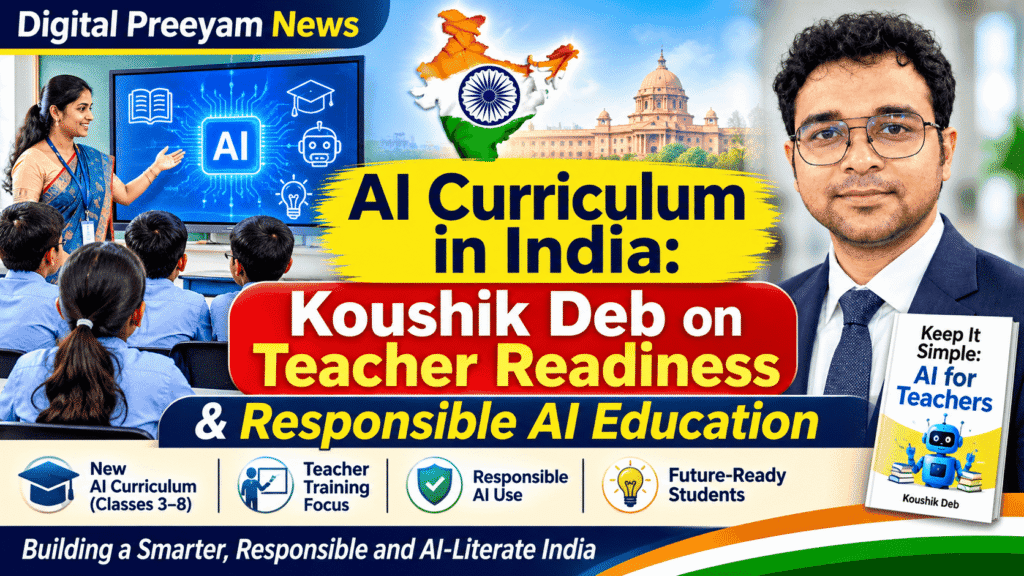
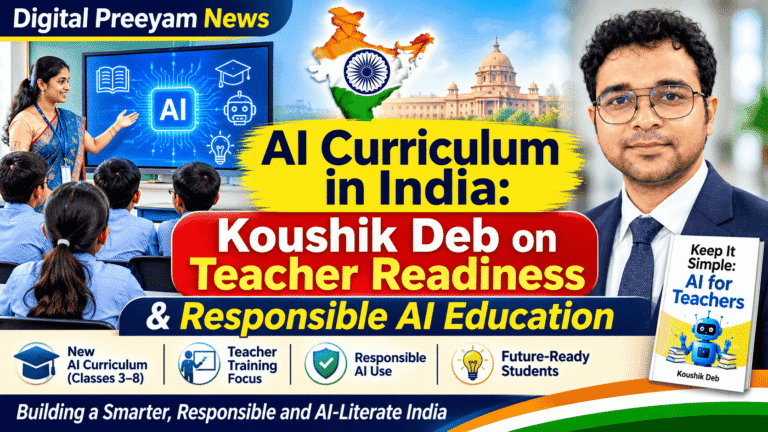
AI Curriculum in India: Koushik Deb Highlights the Importance of Teacher Readiness and Responsible AI Education
India's education system is entering an important phase as Artificial Intelligence (AI) and Computational Thinking become part of school-level learning. With the introduction of a dedicated AI curriculum for Classes III to VIII from the 2026–27 academic session, the focus is shifting towards developing technological awareness, logical reasoning and responsible digital skills among young learners. However, the success of this initiative will depend not only on what students learn but also on how effectively teachers are prepared to introduce these emerging concepts in classrooms.
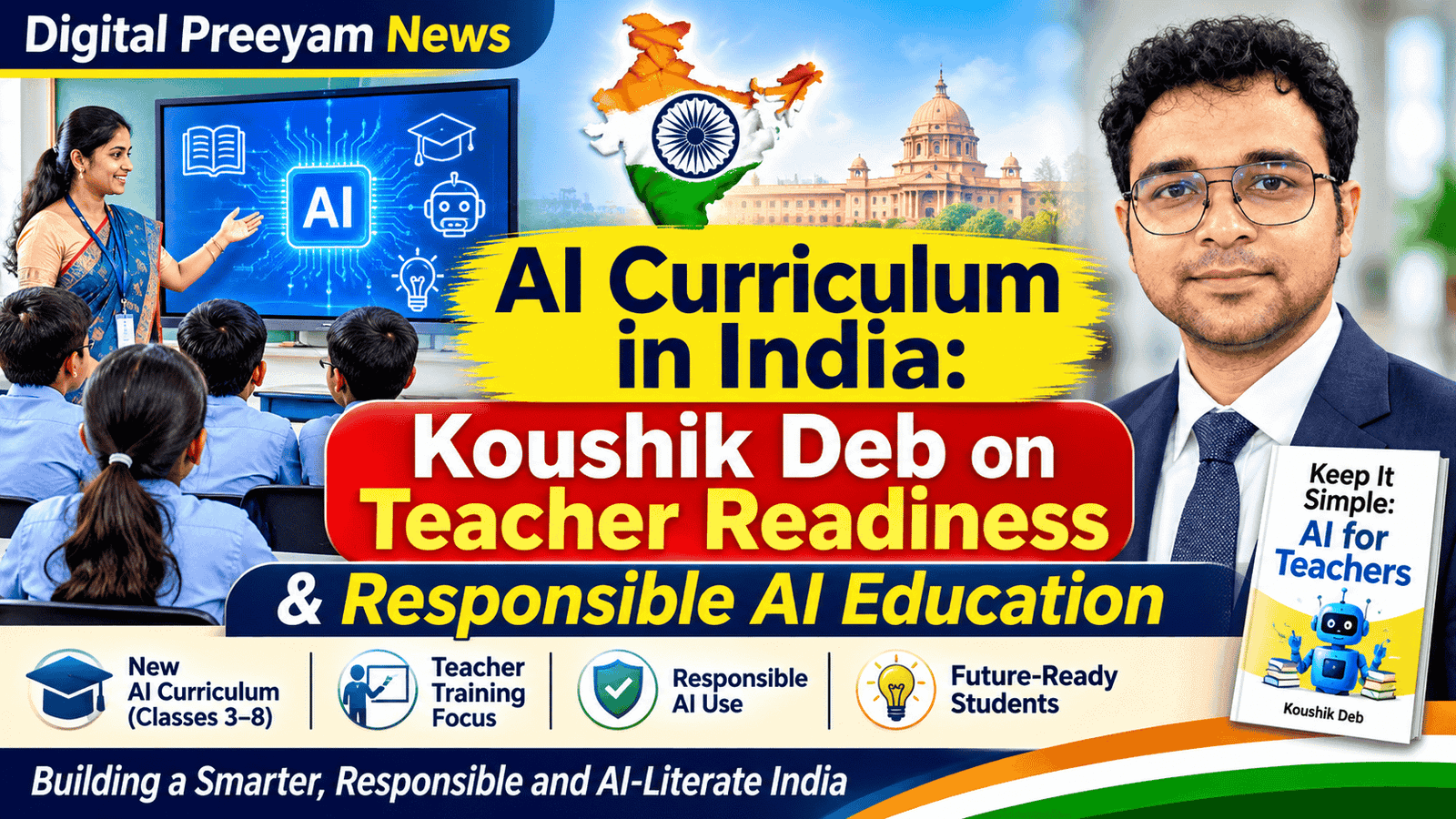
The growing importance of the AI curriculum in India reflects a wider effort to prepare students for a technology-driven future. While artificial intelligence is increasingly influencing professional industries, research and everyday activities, schools now have an opportunity to introduce its fundamental concepts through age-appropriate educational methods.
For teachers, this development also creates a new responsibility: understanding how AI works, identifying its limitations and helping students develop the ability to use technology thoughtfully.
India's New AI Curriculum: A Significant Development in School Education
The Government of India has been working towards integrating Artificial Intelligence and Computational Thinking into the school education system in alignment with the National Education Policy (NEP) 2020 and the National Curriculum Framework for School Education (NCF-SE) 2023.
In April 2026, the Central Board of Secondary Education (CBSE) introduced its Computational Thinking and Artificial Intelligence curriculum for Classes III to VIII for the 2026–27 academic session.
The initiative aims to develop foundational abilities such as logical reasoning, problem-solving, pattern recognition and an understanding of how AI influences everyday life.
According to the Ministry of Education, the curriculum also emphasises data literacy, algorithm design, creativity, innovation and the responsible and ethical use of artificial intelligence.
Rather than treating AI as simply another technology subject, the framework places Computational Thinking at the foundation of AI learning.
This approach is intended to help students understand how problems can be analysed and solved systematically before moving towards more advanced technological concepts.
What Does the AI Curriculum in India Aim to Teach Students?
The introduction of AI education at an early stage represents a broader shift in how students may interact with technology throughout their academic journey.
Key Learning Areas of AI Education
Computational Thinking and Logical Reasoning
Students are introduced to methods of analysing problems, identifying patterns and developing step-by-step solutions.
These abilities can support learning across mathematics, science and other academic subjects.
Understanding Artificial Intelligence
Students can gradually develop an understanding of what artificial intelligence is, how AI applications operate and where they are used in everyday life.
The objective is to make technological concepts accessible without requiring advanced programming knowledge at the initial stages.
Data Literacy and Problem-Solving
Understanding information and recognising patterns are important foundations of AI.
Students can explore how data is organised, interpreted and used to support decisions through suitable classroom activities.
Ethical and Responsible AI Education
An important component of the curriculum is developing awareness of the responsible use of artificial intelligence.
Students need to understand that AI-generated information may contain mistakes and that technology should be used with critical thinking, fairness and appropriate judgement.
Creativity and Interdisciplinary Learning
Computational Thinking and AI concepts can connect with different subjects, encouraging students to explore practical problems and develop creative approaches to solving them.
These learning areas demonstrate that AI education is not limited to operating digital tools. It also involves developing the thinking abilities required to understand and evaluate technology.
Why Teacher Readiness Is Essential for Successful AI Education
Introducing a new subject or learning framework requires more than preparing textbooks and educational resources. Teachers must also have the knowledge and confidence to explain unfamiliar concepts to students.
The expansion of the AI curriculum in India therefore brings teacher preparation into sharper focus.
Many educators may have extensive experience in their respective academic subjects but limited exposure to artificial intelligence, machine learning or generative AI applications.
Without appropriate preparation, it may become difficult to explain technical concepts, evaluate AI-generated information or identify suitable classroom applications.
Teacher readiness involves several important areas:
- AI Literacy: Understanding fundamental AI concepts, applications and limitations.
- Practical Knowledge: Becoming familiar with relevant AI tools and their educational uses.
- Critical Evaluation: Learning to identify inaccurate, misleading or incomplete AI-generated responses.
- Responsible Technology Use: Understanding privacy, academic integrity, fairness and ethical considerations.
- Classroom Integration: Connecting AI concepts with existing subjects and age-appropriate learning activities.
CBSE has also identified teacher development as an important part of the 2026–27 initiative.
Its training notification places Computational Thinking and Understanding AI at the centre of the year's teacher-training theme. The suggested areas include AI foundations, interdisciplinary teaching, assessment and pedagogy, and ethics and responsible AI use.
This indicates that preparing educators is an important part of implementing the new curriculum effectively.
Government Initiatives Supporting AI Education and Teacher Training
Alongside curriculum development, the Government of India has introduced initiatives to improve AI awareness among students and educators.
One such initiative is SOAR (Skilling for AI Readiness), launched by the Ministry of Skill Development and Entrepreneurship.
The programme includes three progressive 15-hour learning modules for students:
SOAR: Three Learning Modules for Students
A separate 45-hour module designed to develop AI literacy among teachers.
The programme introduces areas such as AI fundamentals, generative AI, programming concepts, cybersecurity, ethics and future career opportunities.
These initiatives highlight the importance of developing AI knowledge among both students and teachers.
However, implementation also requires suitable infrastructure, learning materials and opportunities for educators to develop their skills continuously.
Since education is a subject under the Concurrent List of the Indian Constitution, state and Union Territory governments also have important responsibilities in implementing school-level educational initiatives.
The availability of resources and infrastructure may therefore play an important role in how effectively AI education reaches different schools.
The Importance of Responsible AI Education in Indian Classrooms
As AI applications become increasingly accessible, students may encounter tools capable of generating written answers, explaining academic concepts, creating images and assisting with research.
Although these applications can support learning, their responses should not automatically be considered accurate or reliable.
AI systems can produce incorrect information, overlook important context and reflect limitations in the data used to develop them.
This makes responsible AI education particularly important.
Teachers can help students develop healthy digital habits by encouraging them to:
- Verify important information using reliable educational sources.
- Understand the difference between original work and AI-generated content.
- Avoid sharing confidential or personal information with AI platforms.
- Use AI as a learning assistant rather than a replacement for independent thinking.
- Recognise the importance of fairness, transparency and academic integrity.
The purpose should not simply be to teach students how to obtain answers from AI applications. It should be to help them understand, question and evaluate the information these systems provide.
Koushik Deb: Connecting AI Engineering, Research and Teacher Education

Koushik Deb
AI Engineer and Tech Lead at Accenture
An AI professional whose experience brings together industry engineering, academic research and teaching, with an interest in making artificial intelligence more accessible and understandable.
As India expands its approach to artificial intelligence education, the need for accessible learning resources is becoming increasingly relevant.
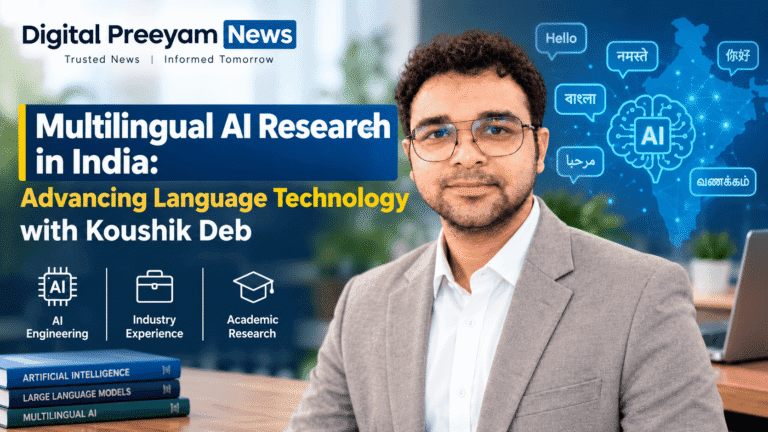
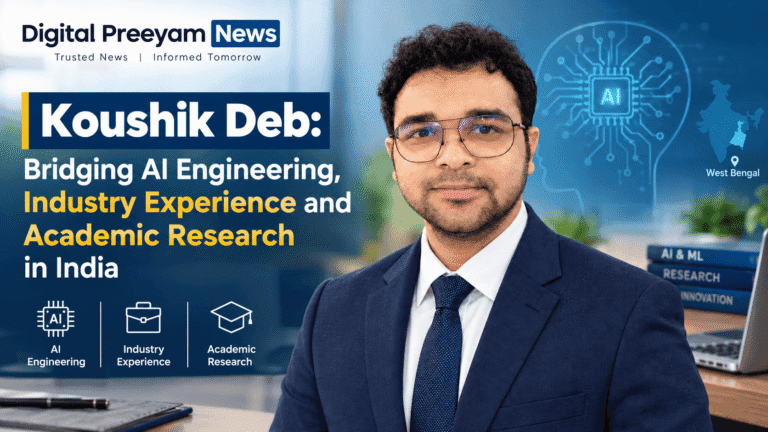
Koushik Deb, an AI Engineer and Tech Lead at Accenture, is among the professionals contributing to the wider discussion around artificial intelligence, research and practical AI knowledge.
He is also a PhD candidate at the Indian Institute of Information Technology (IIIT) Kalyani, where his research focuses on bias detection and mitigation in multilingual large language models across English, Hindi and Bengali.
His professional experience spans Generative AI, Agentic AI, Natural Language Processing (NLP), machine learning and large language models.
Professional Experience and Expertise
Before his current role, he worked with organisations including Cognizant, IBM and Capgemini. He has also worked as an Assistant Professor in Computer Science at the Institute of Engineering & Management, Kolkata.
This combination of industry experience, academic research and teaching background provides a relevant perspective on the relationship between emerging technologies and education.
His work also connects with an important question facing educators today: how can artificial intelligence be made understandable and useful to people who do not have a technical background?
Keep It Simple: AI for Teachers – Making Artificial Intelligence Accessible to Educators
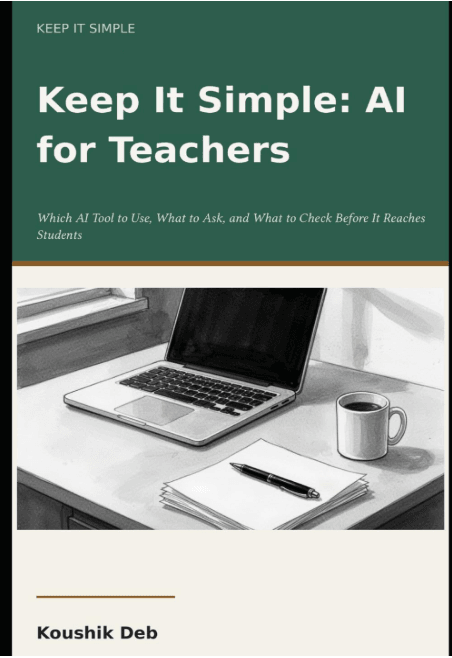
Keep It Simple: AI for Teachers
An educational publication designed to help teachers and education professionals understand artificial intelligence and explore its practical applications without requiring an advanced technical background.
One of Koushik Deb's educational contributions is his book, Keep It Simple: AI for Teachers.
The publication is designed to help teachers and education professionals understand artificial intelligence and explore its practical applications without requiring an advanced technical background.
As AI tools become more common in educational environments, educators need accessible explanations of what these applications can do, how to interact with them and what precautions should be considered before using their outputs.
The book addresses this learning need by presenting AI-related knowledge in a straightforward and approachable manner.
For teachers beginning their journey into artificial intelligence, developing an understanding of AI tools, prompt writing and response evaluation can provide a useful foundation.
Building Practical AI Literacy for Educators
Rather than encouraging dependence on technology, the broader importance of AI literacy lies in helping educators make informed decisions about when and how these tools should be used.
Explore Keep It Simple: AI for Teachers by Koushik Deb
Teachers, academic professionals and readers interested in educational technology can explore Koushik Deb's book, Keep It Simple: AI for Teachers.
The book is available in Kindle and paperback editions through Amazon.
Readers can visit the official book page to explore the publication, access the available free sample and check purchasing options.
Amazon link opens a search for the book title and author. Check the available editions and listing details before purchasing.
Challenges in Implementing the AI Curriculum Across India
Although the introduction of AI education represents an important development, its effective implementation will require attention to several practical challenges.
Access to Digital Infrastructure
Schools may have different levels of access to computers, internet connectivity and digital learning resources. These differences can influence how students experience AI-related activities.
Continuous Teacher Development
AI technologies evolve rapidly. Teachers will need opportunities for continuous learning rather than relying only on one-time training programmes.
Age-Appropriate Educational Materials
Students at different academic stages require different approaches to learning. Educational resources should introduce AI concepts gradually, using examples and activities suitable for their age groups.
Regional Language Accessibility
India has a diverse linguistic environment. Making AI learning resources accessible in different Indian languages can help expand participation and understanding.
Maintaining Academic Integrity
Schools will also need to establish appropriate guidelines for the use of AI-generated content in assignments, projects and assessments.
The Future of AI Education in India
The integration of Artificial Intelligence and Computational Thinking into school education represents an important step towards developing future-ready learners.
As the AI curriculum in India expands, the focus is likely to extend beyond technical awareness towards problem-solving, digital responsibility, creativity and informed decision-making.
Teachers will remain central to this transformation. Their ability to explain concepts, guide classroom discussions and encourage independent thinking will influence how students understand and apply emerging technologies.
Educational resources, professional development programmes and responsible technology policies can collectively support this transition.
At the same time, schools must ensure that AI does not replace meaningful teacher-student interaction or the development of fundamental academic abilities.
Technology can provide additional learning opportunities, but effective education will continue to depend on human understanding, subject knowledge, creativity and responsible guidance.
Building a Responsible AI-Literate Generation
The introduction of the new AI curriculum marks an important development in India's approach to school education.
However, the long-term value of this initiative will depend on how effectively its objectives are translated into classroom experiences.
Preparing teachers, developing accessible learning materials and encouraging responsible AI practices will be essential to this process.
The work of professionals such as Koushik Deb, who bring together AI engineering, academic research and educational knowledge, also reflects the growing importance of making artificial intelligence understandable beyond the technology industry.
Ultimately, the goal of AI education should not simply be to prepare students to use advanced digital tools. It should be to develop a generation capable of understanding technology, questioning its outputs and applying it responsibly.
Social Media Profiles
Follow Digital Preeyam News on social media for the latest stories, insights and updates.
Frequently Asked Questions (FAQs)
Find answers to common questions about India's AI curriculum, teacher readiness and the growing importance of AI education.
01 What is the AI curriculum in India? +
The AI curriculum in India introduces students to Artificial Intelligence and Computational Thinking through age-appropriate educational activities. It aims to develop logical reasoning, problem-solving, data literacy, creativity and an understanding of responsible AI use.
02 From which academic session will the new AI curriculum be introduced in Indian schools? +
The CBSE Computational Thinking and Artificial Intelligence curriculum for Classes III to VIII has been introduced for the 2026–27 academic session. It focuses on building foundational knowledge of computational thinking and artificial intelligence.
03 Why is teacher readiness important for AI education in India? +
Teacher readiness is essential because educators need to understand AI concepts, evaluate AI-generated information and guide students towards responsible technology use. Proper training can help teachers integrate AI-related topics into classroom learning effectively.
04 Who is Koushik Deb and how is he contributing to AI education? +
Koushik Deb is an AI Engineer, Tech Lead at Accenture and PhD candidate at IIIT Kalyani. Through his professional experience, academic research and book AI for Teachers, he contributes to making artificial intelligence knowledge more accessible to educators.
05 What is Keep It Simple: AI for Teachers by Koushik Deb? +
Keep It Simple: AI for Teachers is an educational book by Koushik Deb designed to help teachers understand Artificial Intelligence and explore its practical applications. It offers an accessible learning resource for educators interested in developing their AI knowledge.